Thesis
The Bajío is heating up: temperature, power demand and what Mexico's hottest cities teach
León has already passed 40 °C and Mexico's grid set a new demand record in July 2026. The Bajío is not Mexicali, but it has less subsidy, less margin and a peak at eight in the evening.
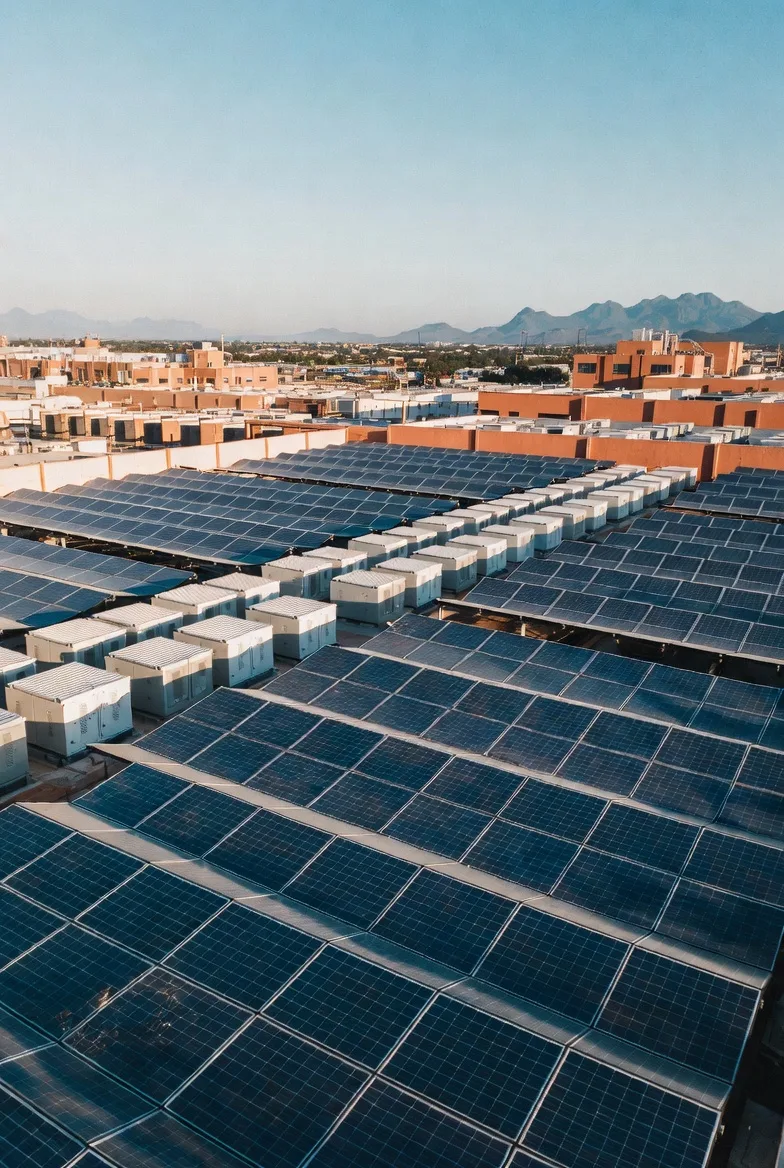
Generation, storage and thermal efficiency for industrial plants in the Bajío.
Let's discuss your projectBajío Ventures · September 2026
The Bajío has always been sold on its mild climate. The León municipal climate sheet still reports a mean annual temperature of 19.2 °C and a maximum of 35.3 °C. In May 2024 the city passed 40 °C in the shade on three separate days, reaching 40.3 °C on 10 May. In July 2026 Mexico’s National Interconnected System set a new demand record. A mild climate is no longer a given, and the power system has less and less margin to absorb the heat.
The mild climate is shifting
- The trend is local, and faster than the global one. Records analysed at the University of Guanajuato show a 3.5 °C rise in the state capital’s temperature between 1940 and 2025; León shows at least 1.5 °C of increase in its annual mean. Part of that is the urban heat island, which is exactly where people live and work.
- Heat waves arrive in May. In the Bajío the hottest month is May, before the rains, when reservoirs are low. On 7 May 2024 CENACE declared an operating emergency at 48,472 MW of demand, well below the record at the time: the problem was not the peak but a reserve margin that fell to 10.56 %, below the 13 % minimum.
- The tariff still assumes it isn’t hot here. CFE assigns residential tariffs 1A to 1F by minimum average summer temperature, from 25 °C to 33 °C, when the threshold is met in three of the last five years. With summers well below that threshold, Bajío cities sit in tariff 1.
How heat reaches electricity use
1. Households: air conditioning without a subsidy. Under tariff 1, a household moves to the High-Consumption Residential Tariff (DAC) once its monthly average exceeds 250 kWh. In Mexicali, under tariff 1F, that limit is 2,500 kWh: ten times higher. A 1.5-ton mini-split used six hours a day draws on the order of 200 kWh a month. In the Bajío, users will pay full price for adapting to the heat.
2. Industry: cooling is part of the process. Chillers, compressors, clean rooms and mould cooling use more power with every degree of outdoor temperature, and they do so during operating hours. The most visible case is Querétaro, with at least 30 data centres, the largest concentration in the country. Mexico has about 279 MW of data centres and aims for 1,500 MW by 2030. Each operator chooses between cooling with water, in the state with the sixth-highest water stress, or with more electricity.
3. The grid: less capacity exactly when it is needed. Overhead lines and transformers lose capacity as ambient temperature rises. Crystalline-silicon PV modules lose around 0.3–0.4 % of output for every degree of cell temperature above 25 °C. Heat raises demand and cuts supply at the same time.
4. The peak comes at night. On 23 July 2026 the interconnected system reached 54,124 MW, above the 53,702 MW of 2023. CFE attributes the growth to heavy industry, data centres and digitalisation; heat was the trigger. The peak came after eight in the evening, when the sun is no longer generating and homes and buildings are still hot. In our analysis of CENACE prices for the Bajío’s load zones, hour 20 costs on average 2.1 times hour 11.
Mexico’s hottest cities
| City | Highest recorded temperature | Date |
|---|---|---|
| San Luis Río Colorado, Sonora | 52.5 °C | 6 Jul 1966 |
| Mexicali, Baja California | 52.4 °C | 8 Jul 2024 |
| Tepache, Sonora | 52.0 °C | — |
| Hermosillo, Sonora | 48 °C | — |
| León, Guanajuato (reference) | 40.3 °C | 10 May 2024 |
SMN and Conagua records as reported in the press. Dates marked — were not published with the figure.
What sets these cities apart is not one extreme day but duration: months on end in which night-time lows don’t drop. That is why Mexicali is on tariff 1F, and why its power system was built, for decades, around air conditioning.
What they teach those preparing now
1. Envelope first, air conditioning second. In 1990 CFE set up FIPATERM in Mexicali, a revolving trust to insulate roofs and replace equipment. By 2013 it had financed 120,703 thermal-insulation jobs and 476,189 air-conditioner replacements, and the programme as a whole, which also replaced refrigerators and lamps, had saved 3,410 GWh. Insulation alone cut household consumption by about 28 %. In the Bajío, every industrial building and housing development built today without insulation or a reflective roof is consumption that will be paid for over 30 years.
2. Subsidies arrive late. The three-in-five-years rule means tariffs follow the climate with a lag. In 2026 Sonora applied the summer tariff in all 72 of its municipalities for the first time. The Bajío will not be reclassified any time soon, so the market for rooftop solar, efficient equipment and insulation will move on price, not policy.
3. Generation is not enough: distribution decides. In May 2026 the 745.4 MW González Ortega combined-cycle plant entered service in Mexicali. In July some neighbourhoods went more than 20 hours without power in temperatures above 50 °C. Many of those failures occur in the distribution network, not in generation. In the Bajío, where industrial and residential areas are growing faster than the grid, the bottleneck is the grid.
4. Size for the evening peak. A solar roof helps at midday, but the peak falls at eight in the evening. What lowers cost is shifting energy from one hour to another: behind-the-meter batteries and thermal storage, meaning chilled water or ice made with solar power to cool in the afternoon. In an increasingly tight system, the value lies in the hour, not the kWh.
5. Water is part of the power equation. Water cooling saves electricity and spends a scarce resource; air cooling does the opposite. In a region already debating the water of the Laja River, cooling projects should be assessed on both accounts.
What it means
In the Bajío, heat is not yet a residential-subsidy problem, as it is in Mexicali. It is a problem of industrial reliability and of price at the evening peak. The opportunities lie in generation paired with storage sized for the evening, thermal storage at plants with cooling loads, insulation of industrial buildings, and dedicated substations in industrial parks. All of them are cheaper if done before the next heat wave.
Sources: León municipality, climate · Periódico AM, León reaches 40 °C, May 2024 · POPLab, climate change already affects Guanajuato · El Financiero, the 7 May 2024 emergency · adn40, summer tariff criteria, Aug 2026 · El Imparcial, why Mexicali pays more for power, Sep 2026 · Expansión, data centres and water stress in Querétaro, May 2026 · Hoja de Ruta Digital / CFE, demand record in all three systems, Jul 2026 · El Financiero, electricity demand record, Jul 2026 · El Informador, cities with extreme temperatures, May 2026 · Infobae / SMN, hottest regions, Apr 2024 · FIPATERM, experience and results, 2014 · adn40, summer tariff in all 72 Sonora municipalities, Jul 2026 · Own analysis of CENACE nodal prices (MTR, 12 months to Sep 2026)
This content is for information only and does not constitute legal, regulatory or investment advice.
Bajío Ventures — a Mexican energy-infrastructure investment group based in Guanajuato: capital, a data platform on the region’s industrial base, and a German industrial channel, with its own advisory presence in Berlin.
Generation, storage and thermal efficiency for industrial plants in the Bajío.
Let's discuss your projectThis article is also available in Spanish. Read in Spanish