Insights
Notes from the Bajío
Short, practical analysis on infrastructure, energy and industry in central Mexico. No noise.
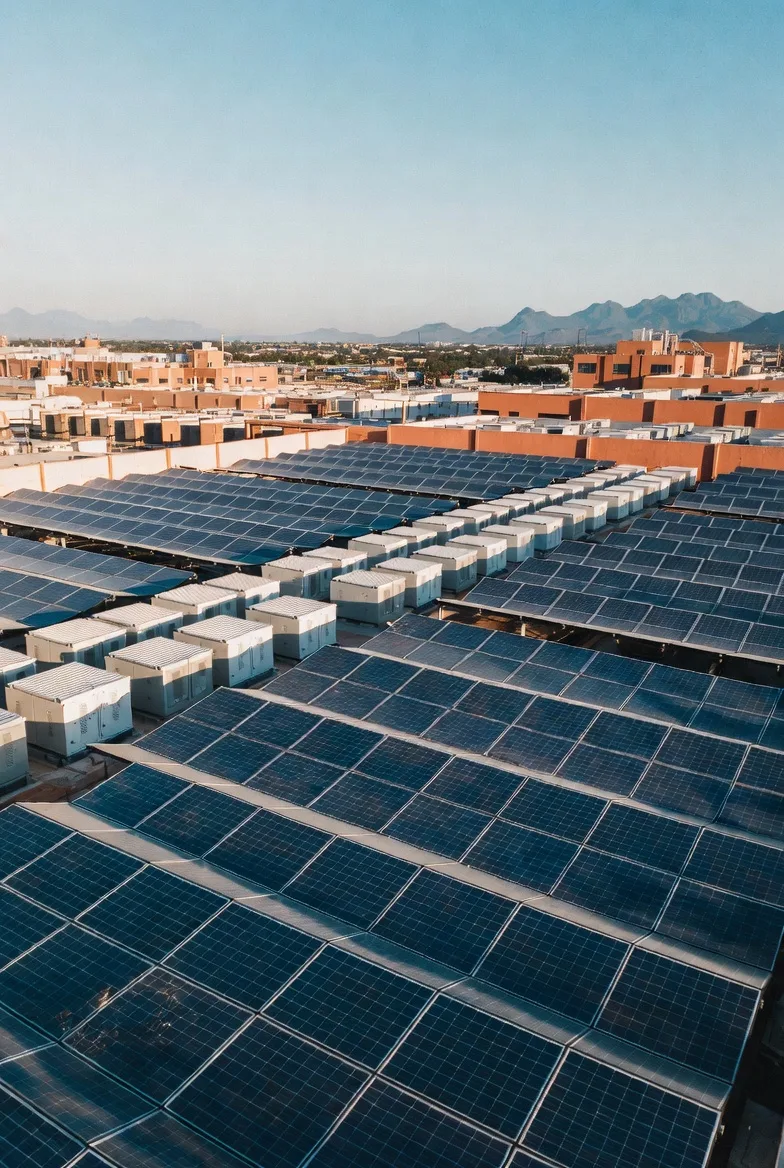
Featured · Thesis
Permitting is no longer the problem
Halfway through Mexico's 2024–2030 National Energy Plan, the binding constraint has moved: from the permit desk to the grid. For industry in the Bajío, that changes which decision has to be made, and when.
September 14, 2026 · 7 min
Read articleThesis
October 11, 2026 · 9 min
Twenty million: the North American regions the size of the Bajío-Occidente
The Bajío-Occidente is home to 22.1 million people. North America has only a handful of regions that size: greater Mexico City, the Texas Triangle, Southern California, New York, Florida and the Québec City–Windsor Corridor, plus Guatemala and Hispaniola. With the same number of people, the Texas Triangle produces six times more per person.
Sustainable development
October 10, 2026 · 8 min
Agenda 2030 in the Bajío–Centro-Occidente: four years to go
Eleven of fifteen years on, poverty fell in all six states, but formal employment did not move, lack of health access rose everywhere and 91 of 146 aquifers have no water available. Distributed generation doubled. One table with a source and year for every figure.
Market
October 9, 2026 · 5 min
The Altamira hub, Tamaulipas: the largest, still on paper
At 1,637.78 ha, the Altamira hub is the largest of the 15 and almost twice the size of the second, Reserva Zapotlán (910.82 ha). It has had a state agreement since 18 February 2026, but no developer, no tenants and no published MW figure.
Market
October 9, 2026 · 5 min
The Cancún Financial and Technology District hub, Quintana Roo: declared in August, questioned in September
The newest hub covers 60.76 ha in Benito Juárez and was declared in the DOF on 7 August 2026. On 7 September President Sheinbaum said it can hardly be authorized where there is jungle and that the site is not yet defined.
Market
October 9, 2026 · 5 min
The Chetumal hub, Quintana Roo: 21.5 MW next to Belize, no pipeline, no investment
The Chetumal hub covers 87.80 ha, 7.4 km from the Belize border, and offers up to 21.5 MW, with compressed natural gas instead of a pipeline. As of October 2026 it is still in pre-investment, with no companies or investment announced.
Market
October 9, 2026 · 5 min
The Durango hub (CLID): an existing park with 8.6 MW and a USD 1 billion project
The Durango hub is the Centro Logístico e Industrial de Durango, an operating park of 315.42 ha with a substation 100 m away and a 93 ha solar park. A USD 300 million plus USD 700 million automotive project has been announced, with no company named, against projected capacity of 8.6 MW.
Market
October 9, 2026 · 5 min
The Hermosillo hub, Sonora: from 7 MW to 220 MW on paper
The Hermosillo hub covers 546.46 ha in three polygons northeast of the city. SENER's opinion in the DOF grants it 1 to 7 MW; the Proyectos México sheet now mentions reinforcement works for up to 220 MW.
Market
October 9, 2026 · 5 min
The Huamantla hub, Tlaxcala: the first one open, with 8 MW for USD 540 million
Huamantla is the only inaugurated hub: it opened on 12 April 2026, seven months after works began, with USD 540 million announced and up to 6,000 jobs. The official sheet assigns it 8 MW, little power for an auto-parts and metalworking park.
Market
October 9, 2026 · 5 min
The Nezahualcóyotl hub, State of Mexico: urban land next to the airport, no developer
68.37 ha on the Mexico City boundary, with gas, power and rail inside the polygon and projected demand of 5 to 7.7 MW. Fourteen months after its declaration it is still in pre-investment, with no companies and no official investment figure.
Market
October 9, 2026 · 6 min
The Parque Industrial Bajío hub, Michoacán: 342 ha beside Lake Cuitzeo, waiting for its environmental permit
The Michoacán hub was the first to be formalised and is named, on purpose, Parque Industrial Bajío. It has 342 ha in Zinapécuaro, named developers and 12.9 MW published, but as of October 2026 its environmental impact statement is still unresolved.
Market
October 9, 2026 · 5 min
The Puebla Technology and Sustainability hub: named companies, long timeline
The Puebla hub covers 217.68 ha in San José Chiapa and Nopalucan and already has four companies with 2,080 million pesos announced. The government spoke of 90% progress in March 2026, but in August it set 2029 or H1 2030 to finish the works.
Market
October 9, 2026 · 5 min
The Puerta Logística del Bajío hub, Guanajuato: a rail node still waiting for works
52.41 ha next to Honda's plant in Celaya, with access to Ferromex and CPKC and MXN 2,500 million committed for phase 1. Guanajuato Puerto Interior now points to a construction start in Q2 2027, not Q1 2026.
Market
October 9, 2026 · 5 min
The Reserva Zapotlán hub, Hidalgo: the developer is in, the grid is not
The Reserva Zapotlán hub covers 910.82 ha in the AIFA corridor and, since 19 August 2026, has a developer: DEWA Capital, with more than 10,100 million pesos over five phases. SENER estimates 20 MW at maturity, with the high-voltage connection about 24 km away.
Market
October 9, 2026 · 5 min
The San Jerónimo hub, Chihuahua: on the border, still in planning
The San Jerónimo hub covers 60.32 ha next to the Santa Teresa–San Jerónimo border crossing and offers up to 20 MW. As of October 2026 it is still in pre-investment, with no companies or investment announced.
Market
October 9, 2026 · 5 min
The Seybaplaya I hub, Campeche: port and gas at hand, no tenants
The Seybaplaya I hub covers 99.99 ha, 4.9 km from the port of Seybaplaya, with 6 MW available on site through 2030. As of October 2026 it is still in pre-investment, with no developer or announced investment.
Market
October 9, 2026 · 7 min
The 15 welfare hubs as of October 2026: one inaugurated, six under way, eight on paper
There are 15 welfare development hubs declared in the DOF, but they are not the 15 announced in June 2025: one in Hidalgo dropped out and Cancún came in. As of October 2026 only Huamantla has been inaugurated, and the power capacity assigned to each hub rarely exceeds 20 MW.
Thesis
October 9, 2026 · 8 min
The Michoacán hub and Guanajuato: one corridor
Parque Industrial Bajío is in Michoacán, but its labour market, its basin and its rail outlet face Guanajuato: Acámbaro is 46 km away and Celaya 111 km along the same CPKC line. With the Celaya hub, it forms a pair on a single line. No government has framed it that way.
Market
October 9, 2026 · 5 min
The Topolobampo hub, Sinaloa: gas at the gate, conflict in the bay
The Topolobampo hub covers 277.58 ha in Ahome, with up to 10 MW and the El Encino–Topolobampo gas pipeline at the site boundary. Along with Cancún, it is the only hub without a located SE–state agreement, and its surroundings carry the conflict over the ammonia and methanol plants.
Market
October 9, 2026 · 5 min
The Tuxpan hub, Veracruz: 235 ha next to the port and only 4 MW
235.10 ha 7.7 km from the port of Tuxpan, aimed at logistics, energy and heavy industry, but with projected power demand of just 4 MW. Fourteen months after its declaration there is no developer and no tenant; in March 2026 the state created a committee to pick them.
Sustainable development
October 8, 2026 · 8 min
From commitment to project: what Bajío Ventures can do
The commitments are signed and the targets are written. What is missing in the Bajío lies in between: regional measurement, prepared projects and a way to aggregate what is small. Seven lines of work for a company of our size, each with its indicator, and three things that are not ours to do.
Regulation
October 8, 2026 · 7 min
Project support desks: what Jalisco can do
The federal government has opened its single windows for energy. None of them covers what the state and the municipalities decide. Jalisco has already solved that stretch for industrial parks; it now has to apply it to energy projects and, above all, to the grid.
Technology
October 7, 2026 · 8 min
Sovereign AI: what it means and which open models exist
Sovereignty in artificial intelligence does not mean building everything at home: it means being able to decide. Open-weight models already solve the model layer. The missing layer is electrical, and that layer is decided substation by substation.
Sustainable development
October 7, 2026 · 9 min
The Bajío states and the 2030 Agenda
Five states, five ways to put the SDGs into practice. Three charge per tonne of CO₂, at different prices. Two have a net-zero emissions target. Only one has an energy ministry. Water is the weak point of all five. And there is no regional table.
Technology
October 6, 2026 · 7 min
Spanish-language models and the case of Mexico: ALIA, Latam-GPT and Coatlicue
Spain has already published a public Spanish-language model under an open licence. Latin America has its own, built on a Meta model. Mexico has a plan, a supercomputer on the way and one published model, fine-tuned on a French one. The constraint that decides everything is a different one: megawatts.
Sustainable development
October 6, 2026 · 9 min
What the federal government is doing: plans, budgets and gaps
The federal government has a plan, new laws and an absolute climate target. It also has four different official figures for clean energy in 2030 and a climate annex that falls 25% in the 2027 budget. An inventory of what is moving forward and what is missing.
Technology
October 5, 2026 · 6 min
China: 41% of downloads and a question of trust
The world's top-rated open models are Chinese, and their licences carry more conditions with each release. They run without sending data to anyone. The question for a Bajío exporter is not technical: it is what the customer will say.
Technology
October 5, 2026 · 6 min
United States: open weights, closed flagships
Google, OpenAI and IBM publish mid-sized models under the Apache 2.0 licence, at a size that fits on one server. The frontier model stays closed. For an industrial plant, that mid-sized range is exactly the one that is useful.
Technology
October 4, 2026 · 6 min
Mistral: Europe's champion and the fine print in its licences
Mistral did what Aleph Alpha stopped doing: it kept training models and built its own compute. EUR 3 billion in September, a 1.4 GW campus on the way and three types of licence that are worth telling apart.
Sustainable development
October 4, 2026 · 9 min
What Mexico signed: agreements that bind and agreements that guide
Paris, Escazú, Convention 169, the USMCA, the new agreement with the European Union. They do not all carry the same weight. A guide to tell the treaty that a judge can apply from the declaration that only guides, and what each one asks of an energy or industrial project.
Technology
October 3, 2026 · 7 min
Aleph Alpha: Germany's sovereign AI lesson
Seven years, a round announced as more than USD 500 million, a change of strategy and a merger with Canada's Cohere. On 3 October it released Kolibri-1, its first open-weight language model under Apache 2.0.
Sustainable development
October 3, 2026 · 7 min
SDGs: four years from 2030, where the world and Mexico stand
Only 15% of the global targets are on track. Mexico ranks 75th of 169 and has achieved none of the goals. Its best figure is poverty. Its worst are institutions, inequality and industry. SDG 9 is in red in a country that lives from manufacturing.
Sustainable development
October 2, 2026 · 7 min
MDGs: the eight goals that taught us to measure
Between 2000 and 2015 the world set itself eight goals with a date and with indicators. Mexico met 37 of 51. The ones it did not meet — maternal mortality, emissions, forests, pressure on water resources — are today's agenda. And one goal was never written: energy.
Thesis
October 2, 2026 · 9 min
Six axes and one condition: an energy agenda for the Bajío
Energy security, a renewable mix of 40 to 60%, agrivoltaics, bioenergy and hydrogen, distributed generation and efficiency. Six lines of work for the region and one condition that runs through all of them: energy justice. Each with its starting point and what we propose to measure.
Events
October 1, 2026 · 4 min
EECE Expo 2027: energy moved to the factory floor
Informa Markets has launched EECE Expo, an energy-efficiency and circular-economy trade show to be held in Monterrey alongside Expo Manufactura. The underlying figure: the North and the Bajío-West together hold more than half of Mexico's distributed generation.
Market
October 1, 2026 · 6 min
Who builds Mexico's industrial parks? What the map says about the Bajío
Querétaro ties for second place nationally in number of industrial developers and Guanajuato has 13, but only a dozen firms operate in more than four states. The map shows who builds the buildings; it does not show who can power them, which is what now decides which park fills up.
Thesis
September 30, 2026 · 10 min
Long hours, low skills: what Mexico can learn from countries that turned it around
Mexico works more hours than any other OECD country, and its 15-year-olds scored 388 in PISA 2025 mathematics, 75 points below the OECD average. Portugal, Poland, Peru and the Brazilian state of Ceará started from similar positions and moved their results. This is what they did.
Infrastructure
September 30, 2026 · 7 min
Windmills, giants and the wind we don't use
From Hildegard of Bingen to Don Quixote, wind has always moved something. Mexico has close to 8 GW of onshore wind, only one farm of it in Jalisco, and not a single turbine at sea, where the resource is almost twenty times larger.
Infrastructure
September 29, 2026 · 5 min
Guanajuato's stake in the passenger train: stations, money and industry
Guanajuato does not pay for the train; the federal government does. Guanajuato's role is to be where the train stops: 11 planned stations across three lines. What the state gains depends on what gets built around them.
Infrastructure
September 28, 2026 · 6 min
The new Mexico City–Querétaro–Irapuato train: the logic and the money
The federal government is building 340 km of new double-track passenger railway from Mexico City to Irapuato for about MXN 191 billion, and plans another 303 km to Guadalajara for MXN 127.5 billion. What changed since 2014, and what to check before relying on the numbers.
Market
September 27, 2026 · 7 min
Bajío industrial parks: occupancy and the pace of construction in 2026
Vacancy in the Bajío rose from 3–4% to a 4–6% range, and construction opened the year at a record pace before cooling. This is not deterioration but normalisation after the nearshoring peak. What sets a park apart is no longer free space, but the power it can deliver.
History
September 27, 2026 · 12 min
Who settled the Bajío: 2,600 years told from its cities
The Bajío has filled up and emptied out more than once. Preclassic farmers settled it first; around the year 1000 they abandoned it; silver and wheat repopulated it in the 16th century; by 1803 it was the densest region of New Spain. Today León, Querétaro, San Luis Potosí and Aguascalientes are home to more than five million people, and the order among them is shifting.
Thesis
September 26, 2026 · 5 min
Value chain: the supply that should be made here
The Bajío already assembles transformers and electrical equipment for North America. What it does not make is what goes inside: cores, winding wire, long-lead components. That is where the queue is, and where the opportunity is.
Thesis
September 25, 2026 · 4 min
Mexico and North America: an interdependence to manage
Mexico buys some of the cheapest gas in the world because it is integrated with the United States. That same integration leaves it with 2.4 days of reserves.
Electromobility
September 25, 2026 · 4 min
The Bajío and sovereignty: where the value stays
Guanajuato leads Mexico's electric vehicle supply base. In electromobility, sovereignty is measured by how much of the vehicle's value, know-how and data stays in the country.
Infrastructure
September 25, 2026 · 4 min
The Pacific: Mexico's window to Asia
Energía Costa Azul shipped the first LNG from Mexico's Pacific coast. The route to Asia is shorter and does not depend on Panama, but five of six projects still lack financing and the rules for domestic industry have not arrived.
Infrastructure
September 24, 2026 · 4 min
2027: the year Mexico's power system will be tightest
CFE projects the system's reserve margin at 13.2% in 2027, its low point before new capacity arrives. An industrial plant has months, not years, to prepare.
Infrastructure
September 24, 2026 · 4 min
National content: the opportunity Mexico is letting slip
CFE's 2025–2030 plan implies ~22,800 MVA of power transformation, ~13,600 MVAr of compensation and ~54,500 circuit-km of conductor. The local supply chain is not yet ready to deliver it.
Infrastructure
September 24, 2026 · 4 min
Mexico's power bottleneck isn't generation — it's the grid
For every peso CFE's 2025–2030 plan puts into the grid, it puts about 3.5 into generation. For industry, capacity is decided substation by substation.
Electromobility
September 24, 2026 · 4 min
The brand and the chain: what Mexico makes and what it doesn't
Mexico already designs and assembles electric vehicles under its own brands. The battery cell, the highest-value component, is still imported.
Events
September 23, 2026 · 5 min
Baja California in 2026: the power system that arrives at EnerBaja
Interconnection with the national grid, a new combined-cycle plant in Mexicali, gas now leaving through Ensenada and an open storage call: the context Baja California brings to EnerBaja 2026.
Infrastructure
September 23, 2026 · 5 min
Hydrogen in Mulegé: why isolated grids may become Mexico's greenest
CFE is building its first solar, battery and green-hydrogen project in Mulegé. It is no accident: small, isolated power systems are the ones that can decarbonise fastest, and that is SENER's reasoning.
Infrastructure
September 23, 2026 · 5 min
The line that already exists: what a 67 km reconductoring in Baja California shows about grid capacity in the Bajío
At EnerBaja 2026, Covanaro presented the reconductoring of the 115 kV Cañón–San Quintín line: a new conductor on an existing line, with no new right-of-way and no loss of supply to San Quintín.
Regulation
September 22, 2026 · 9 min
The state of energy investment schemes in Mexico (September 2026)
After the 2024 reform and the 2025 laws, the question for investors is no longer whether there is room for private capital, but under which scheme, in which region and at what price. What SENER presented on the Expansion Plan, and what it means for anyone looking to invest.
Thesis
September 22, 2026 · 7 min
Expensive, stable, long-term rules: what an investor is looking for
Infrastructure investors don't ask for cheap rules. They ask for rules they can price and that last as long as the asset. An expensive rule is paid once; an unstable rule is charged on every cash flow, through the discount rate.
Weekly
September 21, 2026 · 6 min
Power week, 14–21 September: a deadline that did not move, unannounced audits, and batteries that already pay
Corriente BESS, the weekly briefing for investors. Sener extended the legacy-permit migration but not the grace period; unannounced audits reach fuel stations and terminals; and the south-east blackout turned storage into a business case.
Infrastructure
September 20, 2026 · 5 min
The Bajío runs on petroleum fuels: where they come from and what they are used for
Almost everything produced and moved along the León–Querétaro corridor depends on gasoline, diesel or LPG. A refinery in the middle of the region does not guarantee supply, and the traceability of every litre is now a compliance issue.
Thesis
September 19, 2026 · 6 min
The Bajío is heating up: temperature, power demand and what Mexico's hottest cities teach
León has already passed 40 °C and Mexico's grid set a new demand record in July 2026. The Bajío is not Mexicali, but it has less subsidy, less margin and a peak at eight in the evening.
Thesis
September 17, 2026 · 6 min
The last mile: how China brought reliable power to everyone, and why generation is the easy part
China connected its last household without electricity in 2015, then spent 830 billion yuan in four years on rural grids alone. The lesson for investors: generation is bought; the grid is built.
Thesis
September 16, 2026 · 5 min
The Bajío's air: three problems, three maps
Salamanca breathes sulphur dioxide, Celaya breathes particulates, and ozone is rising across the whole corridor. It is not one air-quality problem, and each one has its own investment.
History
September 15, 2026 · 12 min
It started in León: four cycles of Mexico's electricity grid
Mexico's first electrical installation was a 1.8 kW plant built for a textile mill's own use in Guanajuato, in 1879. One hundred and forty-seven years later, the main opening in the current law is called self-consumption. History does not repeat. The physical constraint does.
Electromobility
September 10, 2026 · 4 min
The bus before the car
Transport electrification in Mexico is moving faster in buses than in private cars. In Mexico and in California the pattern is the same: captive fleets with fixed routes and a public or corporate buyer.
Regulation
September 8, 2026 · 6 min
Binding planning: when the State first decides what the country needs
With the 2024–2025 reform, Mexico moved from indicative to binding energy planning: the State defines energy needs and development priorities, and public and private projects align with them.
History
September 6, 2026 · 9 min
Germany in the Bajío: two centuries of technique, half a century of capital
At the September 2 Summit, the Guanajuato government counted nearly 70 German projects and some USD 4 billion. Almost all of it postdates 1973. Before that, Germany had spent two centuries in the Bajío supplying something else: knowledge.
Regulation
September 3, 2026 · 6 min
Three environmental and social changes that set the size of an energy project
A draft new LGEEPA, the MISSE already in force and an environmental impact regulation that did not change. For on-site generation, the 0.7 MW threshold turns out to be an environmental and social boundary as well.
Thesis
September 1, 2026 · 8 min
Why the Bajío, and why energy
Industrial demand is not the problem. Nearshoring investment grew 39% in 2025, and northern Mexico's industrial vacancy still multiplied sevenfold. What broke was the infrastructure underneath — and that is where we work.
Events
August 31, 2026 · 8 min
Summit 2026: what German industry and the Bajío put on the table
On 2 September, the BDI, COPARMEX Nacional, the Konrad Adenauer Foundation and the State of Guanajuato opened a Germany–Mexico industrial agenda in Silao. This is the full record of the day: programme, speakers, panels, and the 61-supplier Catalogue.
Infrastructure
August 25, 2026 · 7 min
Three countries, three answers: grid codes and utilities in Canada, Mexico and the United States
North America shares reliability standards and cross-border lines, but each country answers two questions differently: who writes the connection rules, and who owns the wire. For anyone investing in the Bajío, that difference sets the project's path.
Thesis
August 18, 2026 · 6 min
A just energy transition: what Mexico must prepare
The question is no longer whether Mexico changes its energy mix, but who pays and who keeps the benefit. Four ledgers to prepare before the transition settles them on its own: the coal region, the poor household, the host territory and the public purse.
Thesis
August 11, 2026 · 8 min
The Bajío's hidden energy market: 73 German plants, and almost no on-site generation
German OEMs in the Bajío already run on renewable power. The suppliers around them mostly don't. We sized the gap: roughly 64–183 MWp of on-site solar and US$52–216 million of capex, in projects too small for project finance and too large to ignore.
Regulation
August 4, 2026 · 4 min
Vapour recovery: what NOM-004 requires in Tijuana and the Bajío
Gas stations in Celaya, Irapuato, Salamanca, Villagrán, Tijuana and Rosarito must test their vapour-recovery systems and file the report with ASEA in 2025 and 2026. What the standard requires, and in which months.
Infrastructure
July 28, 2026 · 5 min
Medium-voltage direct current: what CIGRE has documented and what already exists in Mexico
Two CIGRE publications — TB 793 (2020) and the ELECTRA 323 summary of TB 875 (2022) — set out the state of medium-voltage direct current (MVDC) for distribution grids. What they contain, with figures and dates.
Environment
July 21, 2026 · 5 min
Cars and the air we breathe in the Bajío
León had 69 days with particulates above the standard in 2024, and Celaya reached a purple alert in 2025. Cars do not explain everything, but they dominate carbon monoxide, nitrogen oxides and ozone.
Infrastructure
July 14, 2026 · 4 min
Highway 57: Mexico's industrial backbone
Across nearly 1,300 km between Mexico City and Piedras Negras, Highway 57 runs through the country's manufacturing heartland. It was built to connect cities; today it carries the promise of nearshoring.
Thesis
July 7, 2026 · 5 min
The Laja River: water, energy and farming in northern Guanajuato
The Upper Laja River aquifer has 62 hm³ a year more water under concession than it recharges. In northern Guanajuato, a project that produces energy but uses more water is not viable. Five agri-energy models and the rules for doing them right.
Thesis
July 2, 2026 · 6 min
Powering the Bajío's Japanese plants
The Bajío's Japanese automakers have largely solved their clean electricity. Their suppliers have not. Corporate 2035 targets cascade down the chain, and the 2025 rules open the door to 0.7–20 MW self-supply.
History
June 30, 2026 · 7 min
The Manila Galleon, silver and Guanajuato: the first global supply chain ran through the Bajío
For 250 years, silver from Guanajuato's veins crossed the Pacific on the Manila Galleon and ended up paying taxes in Ming China. The Bajío has been the first link in a global chain before. The question then is the question now: where does the value stay?
Market
June 25, 2026 · 5 min
15 versus 19: the tariff that separates a Japanese car made in Japan from one made in the Bajío
Since September 2025 a Japanese car built in Japan pays 15% to enter the United States. The same kind of car built in the Bajío pays on average about 19%. The gap already shows in 2025 output and exports.
Thesis
June 23, 2026 · 6 min
The Mittelstand as long-term owner
A fifteen-year energy contract is a bet on who will still own the plant fifteen years from now. In the Bajío, German family firms have stayed on the same sites for decades. Their risk is not credit: it is succession.
Market
June 18, 2026 · 5 min
150 Japanese companies: the Bajío supply base
Behind every Japanese assembly plant in the Bajío stand dozens of suppliers. Guanajuato counts about 150 Japanese companies. The base is changing its mix: labour-intensive wire harnesses leave, motor cores and steel arrive.
Regulation
June 16, 2026 · 8 min
CENACE: who runs the grid, and what the law tells it to do
CENACE does not generate, transmit or bill a single kilowatt-hour, yet it decides which plant runs, what price every node settles at and whether a new project gets connected. Mexico's 2025 Electricity Sector Law kept its core and changed three words that matter.
Market
June 11, 2026 · 5 min
The Bajío's Japanese automakers by the numbers
In 2025 Japanese brands built one in three light vehicles made in Mexico. Six Bajío plants produced 1.1 million units, 28% of the national total. Two of them already run above 90% of capacity.
Thesis
June 9, 2026 · 5 min
How much each country invests in electricity per person: the United States, China and Mexico
The United States invests at least USD 600 per person a year in its power system; China, about USD 170; Mexico, around USD 50. The gap is not about size: it is about priority.
History
June 4, 2026 · 5 min
Forty years of Japan in the Bajío: from Aguascalientes to Apaseo el Grande
In March 2026 Nissan closed CIVAC, its first plant in Mexico, and moved the output to Aguascalientes. The closure sums up forty years: the centre of gravity of Japan's auto industry in Mexico has moved to the Bajío.
Thesis
June 2, 2026 · 6 min
Industry 5.0: the 400 Gbps network, AI and the person at the centre
The coming factory moves more data in one shift than a factory of ten years ago moved in a month. That pushes the plant backbone from 10 to 100 and 400 Gbps, puts artificial intelligence on the floor, and forces work to be redesigned around the operator, not the other way round.
Regulation
May 26, 2026 · 5 min
What Baja California teaches the Bajío
Baja California is a small system, isolated from the rest of the country and synchronized with California. That's why it hits, early, the problems the rest of Mexico will face within a few years.
Regulation
May 19, 2026 · 4 min
The Bajío's grid is decided in June
Grid expansion runs on an annual cycle. Those who know the calendar can shape it with data; those who don't find out when the capacity is gone.
Regulation
May 12, 2026 · 5 min
24 months: the real interconnection timeline
From application to commercial operation takes 22 to 26 months in the best case. And your place in the queue isn't won when you apply — it's won when you sign.
Regulation
May 5, 2026 · 4 min
Who decides what on Mexico's power grid
An energy project in Mexico doesn't connect to "CFE". It connects to a system with four actors, and each one decides something different. Mixing them up costs months.
Infrastructure
April 28, 2026 · 5 min
One grid: transmission and distribution according to CIGRE, and what it means for the Bajío
The April editorial of ELECTRA, CIGRE's magazine, argues that transmission and distribution are a single system. The same issue carries a Milan case study that puts numbers on that boundary: 10 MW per substation before the transmission operator notices.
Regulation
April 21, 2026 · 4 min
A single file per station
A Mexican fuel station answers to half a dozen authorities, each with its own package, format and calendar. The alternative: a single file the operator maintains, from which each authority reads what it needs.
Regulation
April 14, 2026 · 4 min
One requirement, one standard
Inventory differences from temperature or losses are not fraud: they are physics without a written criterion. The industry needs criteria with substance: measurable, with explicit tolerances, applied the same way by everyone.
Thesis
April 7, 2026 · 7 min
Bavaria's hidden champions, and why the Bajío does not yet have its own
Bavaria has 296 world market leaders in their niche, almost all family-owned and far from Munich. Many already produce in the Bajío. The region hosts their plants, but not their headquarters, their engineering or their ownership.
Regulation
April 7, 2026 · 4 min
The cost of waiting: regulatory latency at Mexico's fuel stations
The time between a station being ready and the authority ruling has a price: idle capital, margin that never comes back, and uncertainty. Almost nobody measures it.
Thesis
March 31, 2026 · 9 min
If the Bajío were in Europe, the US or China
By its industrial model, the Bajío is North America's Central Europe; by its direct competition, the US Southeast; by its income and its reliance on long land corridors, Chongqing; by what it aspires to be, southern Germany. All four cases teach the same lesson: the region's next stage will be decided by energy.
Thesis
March 24, 2026 · 7 min
Where the Bajío lives in the United States
Texas is the first destination for migrants from all four Bajío states: it holds about 44% of their consular ID cards, double its share among Mexicans as a whole. San Luis Potosí sends two out of three there; Aguascalientes spreads across Texas, California, Illinois, Colorado and Oklahoma.
Infrastructure
March 17, 2026 · 6 min
Five Western brands, five Chinese ones: who builds a plant's electrical room
The switchgear, breakers, transformers and UPS in a Bajío plant almost always come from five Western brands. Five Chinese makers now build the same things. What decides which one gets into the project.
Thesis
March 17, 2026 · 5 min
San Luis Potosí in Texas: Houston or Dallas, depending on the municipality
Two out of three migrants from San Luis Potosí live in Texas. Inside Texas they split almost evenly between the Houston and Dallas consular districts, and the municipality of origin decides which: the capital and its neighbours go to Dallas, the Zona Media to Houston.
Environment
March 10, 2026 · 5 min
Four states, three models: how to prepare a project an environmental fund will actually finance
Environmental money exists in three of the four Bajío states, but each fund rewards a different applicant and project. A comparison, which fund for what, and seven steps to a fundable project.
Thesis
March 3, 2026 · 6 min
Residential, C&I and utility: three solar markets that don't look alike
In Mexico, the word «solar» names three different businesses: a home rooftop, the industrial plant that generates for itself, and the park that sells to the grid. The customer, the permit, the risk and who finances it all change.
Environment
February 24, 2026 · 4 min
Aguascalientes: the environmental fund the law calls for, but we cannot yet see
Guanajuato, Jalisco and Querétaro turn vehicle emissions testing into environmental projects. Aguascalientes law calls for an environmental fund, but we found none operating in public sources.
History
February 17, 2026 · 4 min
A century without passenger trains: from the Mexican Central to freight concessions
Between 1910 and 1997 the Bajío kept its railway but lost its passenger train. The line survived as freight infrastructure; people moved to buses and cars on the highway built beside it.
Environment
February 10, 2026 · 5 min
Querétaro: an environmental fund open to companies, academia and civil society
Querétaro's environmental fund is not a trust but an instrument with annual rules, and any individual or organisation can submit a project. Who can apply, what it funds and how projects are scored.
History
February 3, 2026 · 5 min
The Mexican Central Railway: the line that made the Bajío
In March 1884 the Mexican Central tied Mexico City to the border at El Paso along the old Camino Real. Irapuato became a junction, and the station towns of that era are today's industrial cities.
Environment
January 27, 2026 · 5 min
FEPAJ: Jalisco's environmental fund and its bet on co-funding
Jalisco created its environmental fund 16 years after Guanajuato, with a different design: open to NGOs and companies, and built to pull in federal and international money.
Thesis
January 20, 2026 · 7 min
Developer or project seller: the difference that defines your investment
In energy, two trades hand out the same business card. The developer puts capital at risk to turn land into a buildable project; the seller brokers a folder. Paying a development premium for brokerage work is the most expensive mistake in the sector.
Environment
January 13, 2026 · 5 min
FOAM: how Guanajuato funds its municipalities' environmental projects
Since 2000, part of what drivers pay for their emissions-test sticker in Guanajuato has funded garbage trucks, emissions inventories and municipal solar panels. This is how FOAM works.
Infrastructure
January 6, 2026 · 8 min
One country, five maps: how Mexico is divided electrically
Mexico does not have one electricity map; it has five stacked on top of each other. Who operates, who transmits, who distributes, what it costs and where the price is set all follow different borders, and none of them match the states.
Topics
- #PublicPolicy 29
- #Guanajuato 26
- #Investment 24
- #PowerGrid 24
- #Industry 23
- #IndustrialParks 21
- #Logistics 16
- #UnitedStates 13
- #Environment 12
- #Permitting 12
- #SupplyChain 10
- #CFE 10
- #NaturalGas 9
- #Querétaro 9
- #BajaCalifornia 8
- #EnergyPlanning 8
- #Germany 7
- #SDGs 7
- #Rail 7
- #Financing 7
- #AI 7
- #Nearshoring 7
- #TechSovereignty 7
- #Aguascalientes 6
- #EnergyStorage 6
- #SelfSupply 6
- #China 6
- #Jalisco 6
- #Fuels 6
- #CENACE 5
- #Japan 5
- #Solar 5
- #EnergyTransition 5
- #Water 4
- #Interconnection 4
- #SanLuisPotosí 4
- #AirQuality 3
- #Electromobility 3
- #Migration 3
- #CIGRE 2
- #PowerDemand 2
- #Hydrogen 2
- #Talent 2
- #WindPower 1