Regulation
Binding planning: when the State first decides what the country needs
With the 2024–2025 reform, Mexico moved from indicative to binding energy planning: the State defines energy needs and development priorities, and public and private projects align with them.
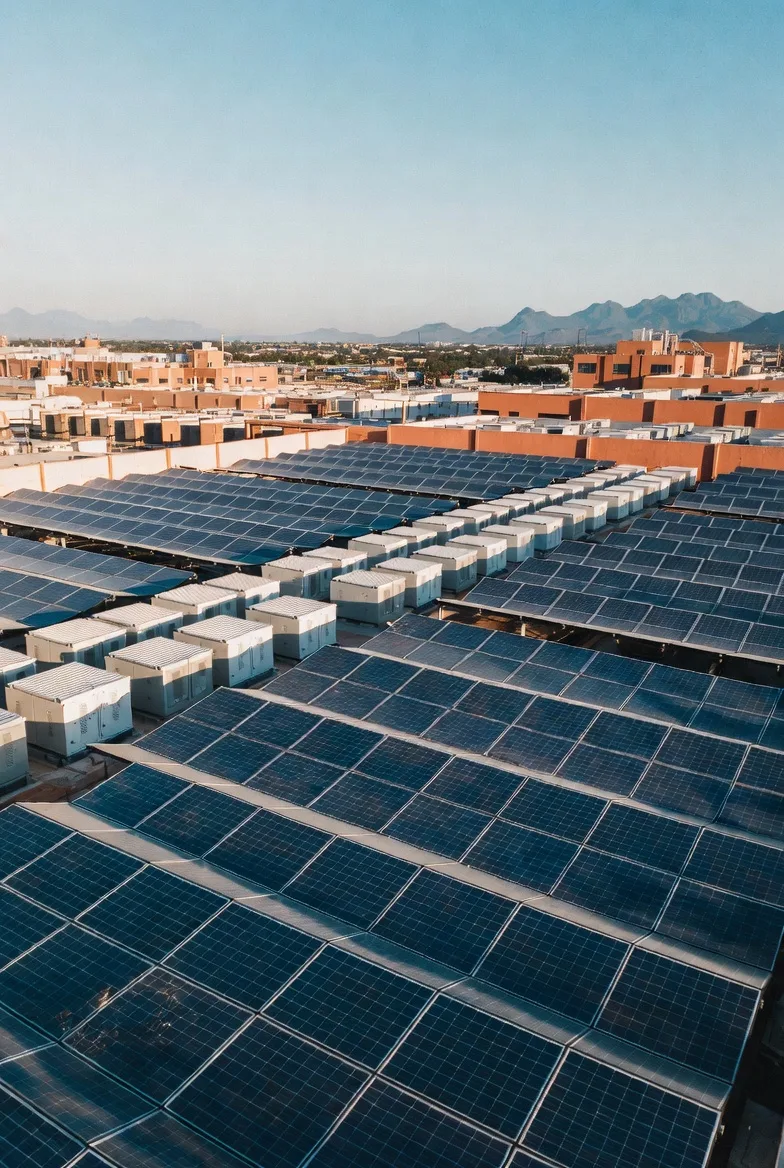
Industrial demand data across the Bajío, park by park and plant by plant.
Let's discuss your projectBajío Ventures · September 2026
For a decade, the expansion of Mexico’s power system responded mainly to market signals. The State planned the grid, and generation planning was indicative: it set out a path that investors could follow or not. With the 2024–2025 reform, Mexico changed the starting point. The State now first defines the country’s energy needs and development priorities, and projects, public and private, align with that plan. This is what is called binding planning (planeación vinculante).
Where it comes from
The change was built in three layers:
- Constitution. The amendment to Articles 25, 27 and 28 (October 2024) redefined the State’s strategic areas and companies.
- Laws. Eight new laws were published on 18 March 2025. Among them, the Energy Planning and Transition Law gives binding planning its legal form.
- Regulations. The implementing regulations detailing how it operates were published on 3 October 2025.
What makes it “binding”
The difference from earlier planning lies in three mechanisms:
- Permits align with the plan. The Ministry of Energy (SENER) and the National Energy Commission (CNE) must take the planning instruments into account when granting permits, contracts, concessions and authorisations.
- The budget follows the plan. The Ministry of Finance must include in the Federal Expenditure Budget the public resources needed to meet the priority objectives.
- There is a monitoring body. The Energy Planning Council, a permanent body of the Ministry of Energy installed in October 2025, coordinates and monitors binding planning. It works through two permanent committees: the Energy Sector Planning Committee (installed 5 February 2026) and the Energy Sector Information Committee (installed 10 June 2026).
The instruments and their status
| Instrument | Horizon | Update cycle | Status |
|---|---|---|---|
| Energy Sector Programme 2025–2030 | Presidential term | Every six years | Published 22 December 2025 |
| National Energy Transition Strategy | 15- and 30-year targets | Medium term every 3 years | In preparation |
| Plan for the Energy Transition and Sustainable Use of Energy (PLATEASE) | 15 years | Annual | In preparation |
| Electricity Sector Development Plan (PLADESE) | 15 years | Annual | Published 17 October 2025 |
| Hydrocarbons Sector Development Plan (PLADESHi) | 15 years (2025–2039) | Annual | Published 7 September 2026 |
The Strategy is the governing instrument and the most exploratory one: it sets out long-term scenarios and targets. The three 15-year plans translate that vision into infrastructure, programmes and projects, and are revised every year. In electricity, CENACE and CFE submit binding 15-year programmes each year for plant additions and retirements and for transmission and distribution expansion; once approved, they are published as the PLADESE, and the Council oversees implementation. In hydrocarbons, the National Energy Commission issues a technical opinion and the Council issues observations before the Ministry approves and publishes the PLADESHi.
The priorities: needs and development first
The Sector Programme sets three objectives:
- Energy self-sufficiency, sovereignty and security, with equitable access to energy, especially in lagging regions.
- Strategic projects in renewables, energy efficiency and innovation, prioritising historically marginalised regions and sectors.
- Energy justice: affordable energy, fair distribution of project benefits and community participation.
The plans turn those priorities into concrete content:
- PLATEASE: must include strategies for smart grids and energy storage, as well as targets for clean energy, efficiency and reducing energy poverty.
- PLADESE: must include an annex with the capacity requirements that private parties may develop, by region and by technology. Private investment does not disappear: it is directed to where the plan identifies a need.
The targets and the starting point
The most recent commitments are in the NDC 3.0 that Mexico presented at COP30:
- 38.5% clean electricity generation in 2030 and 43.3% in 2035.
- Power-sector emissions peaking in 2027.
The starting point is also public. The previous target was 35% clean generation in 2024, and the Sector Programme itself acknowledges that 24% was achieved. Binding planning inherits that gap.
Information: a single national system
The regulations create the National Energy Information System (SNIE), which will gather records, statistics and location data from every entity in the sector and become the official source of energy information. Three features matter to investors:
- Georeferenced data. Obligated parties must report the location of their facilities as a polygon in geodetic coordinates.
- A system of systems. The SNIE integrates the subsystems of the Ministry, its decentralised bodies and the state-owned companies. It had to begin operating by 22 June 2026, and the subsystems have a further 180 calendar days to become interoperable. The National Natural Gas Control Centre (CENAGAS), for example, included in its 2026–2030 institutional programme the centralisation and integration of operational information for the natural gas system.
- Continuity. In the meantime, entities keep publishing on their own platforms, and the Energy Information System (SIE), running since 2002, remains the public reference.
What is still missing
Two of the five instruments are still in preparation: the Strategy, which governs all the others, and PLATEASE, which covers efficiency, storage and energy poverty. The SNIE is under construction and going through interoperability. Organisations such as México Evalúa have noted that transparency and up-to-date energy information will be decisive for citizens to be able to follow the model.
Our position
At Bajío Ventures we believe binding planning will only be as good as the demand information it rests on. Regional industry is growing faster today than substations are arriving, and much of that demand is only visible on the ground: park by park, plant by plant. Planning that organises the country around its needs must, for that very reason, know those needs precisely. That is where we want to contribute.
Sources: Regulations of the Energy Planning and Transition Law · Holland & Knight — LPTE regulations, November 2025 · Energy & Commerce — SENER installs the Energy Planning Council · DOF 16 Dec 2025 — Operating Guidelines of the Energy Planning Council · PLADESE 2025-2039, DOF 17 Oct 2025 · CENAGAS Institutional Programme 2026-2030 · SENER — Energy Information System
Bajío Ventures is a Mexican energy infrastructure investment group based in Guanajuato. It works on three fronts: capital, a data platform on the region’s industrial base, and an industrial channel with Germany, with its own advisory presence in Berlin.
Industrial demand data across the Bajío, park by park and plant by plant.
Let's discuss your projectThis article is also available in Spanish. Read in Spanish