Infrastructure
Mexico's power bottleneck isn't generation — it's the grid
For every peso CFE's 2025–2030 plan puts into the grid, it puts about 3.5 into generation. For industry, capacity is decided substation by substation.
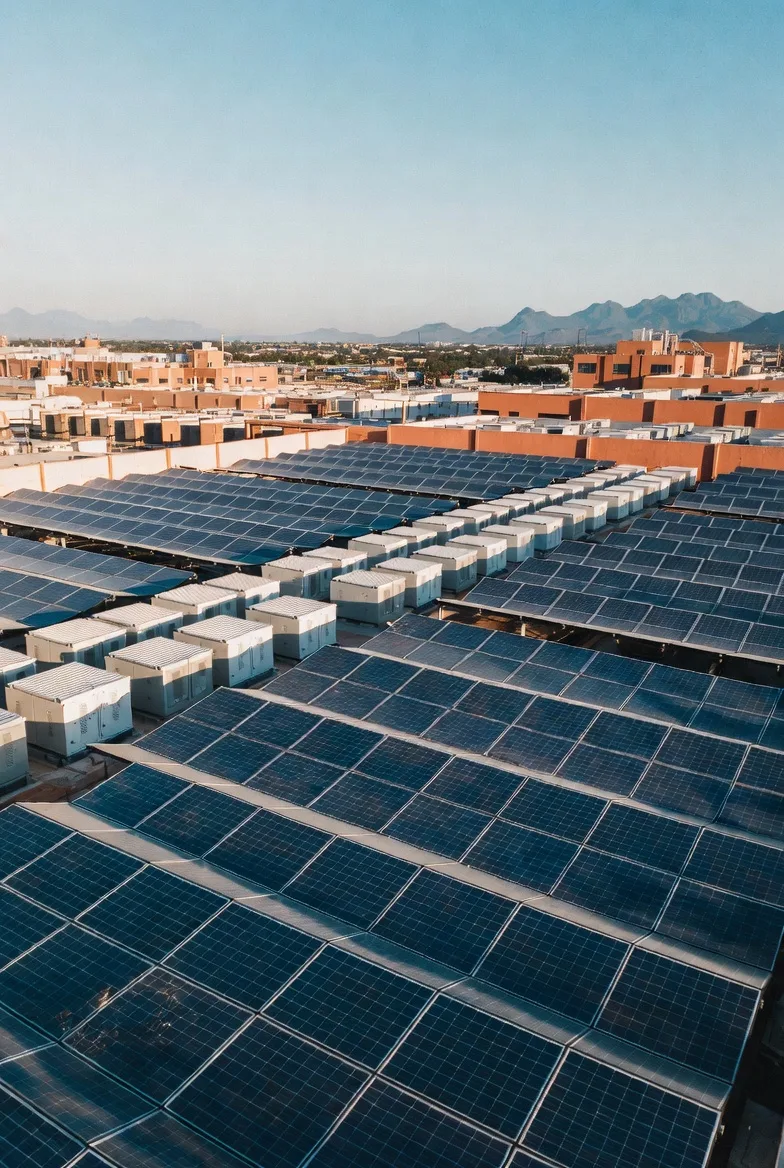
Behind-the-meter generation and storage for industrial plants across the Bajío.
Let's discuss your projectBajío Ventures · September 2026 · CFE’s plan, read from the Bajío, 1 of 3
At EnerBaja 2026, CFE presented the 2025–2030 Plan to Strengthen and Expand the National Electric System, first announced by the federal government in February 2025. The numbers are large: about 49,500 works and an investment of MXN 630 to 670 billion (the presentation showed two versions). The figure that matters most for industry is not the total, but how it is split.
One peso to the grid, 3.5 to generation
Generation takes 70% to 73% of the budget, for 20.6 to 21.8 GW of new capacity. Transmission gets about 20%:
| Transmission 2025–2030 | Volume |
|---|---|
| Lines | 7,545 circuit-km |
| Transformation | 22,832 MVA |
| Reactive compensation | 13,595 MVAr |
Source: CFE slides at EnerBaja 2026.
For every peso invested in the grid, about 3.5 go to generation.
Demand no longer grows evenly
In CFE’s own words, new load centers (industrial parks, nearshoring, data centers, advanced manufacturing) are concentrated at specific points, with loads that used to be spread across thousands of users. A country can have enough generation overall and, at the same time, industrial parks without the substation capacity to connect a new plant. We already saw it in the 46 generation lots left unawarded because the grid was saturated.
Reactive compensation confirms it: 13.6 GVAr against 22.8 GVA of transformation is a high ratio. It signals that the grid already has voltage and stability problems, which will grow as more renewables come online.
What it means for investors in the Bajío
- Location rules. Before buying land or signing an industrial lease, confirm the transformation capacity available and the capacity committed in the PLADESE 2025–2039, published in the Official Gazette in October 2025.
- The PLADESE is binding. Under the new planning framework, what is not in the plan is unlikely to be built. It is the primary source for which substations will arrive and when, together with CFE’s 2025–2039 Distribution Network Expansion and Modernization Program.
- On-site generation stops being optional. Where the grid is slow, behind-the-meter solar with storage can cover demand until capacity arrives.
- Some capacity is already standing. A reconductoring like Cañón–San Quintín doubles a corridor’s thermal capacity with no new right-of-way.
Power infrastructure, CFE said, “no longer just accompanies development; today it must make it possible.” In practice, that is decided substation by substation.
In this series: 1. The bottleneck is the grid · 2. 2027: the year the power system will be tightest · 3. National content: the opportunity Mexico is letting slip
Sources: CFE, 2025–2030 Strengthening and Expansion Plan, EnerBaja 2026 presentation · Proyectos México, Plan de Fortalecimiento y Expansión del SEN: Generación · Factor Energético, plan launch, Feb 2025 · DOF, SENER decree issuing the PLADESE · CFE, Distribution Network Expansion and Modernization Program 2025–2039
Bajío Ventures — a Mexican energy-infrastructure investment group based in Guanajuato: capital, a data platform on the region’s industrial base, and a German industrial channel, with its own advisory presence in Berlin.
Behind-the-meter generation and storage for industrial plants across the Bajío.
Let's discuss your projectThis article is also available in Spanish. Read in Spanish