Thesis
The Bajío's hidden energy market: 73 German plants, and almost no on-site generation
German OEMs in the Bajío already run on renewable power. The suppliers around them mostly don't. We sized the gap: roughly 64–183 MWp of on-site solar and US$52–216 million of capex, in projects too small for project finance and too large to ignore.
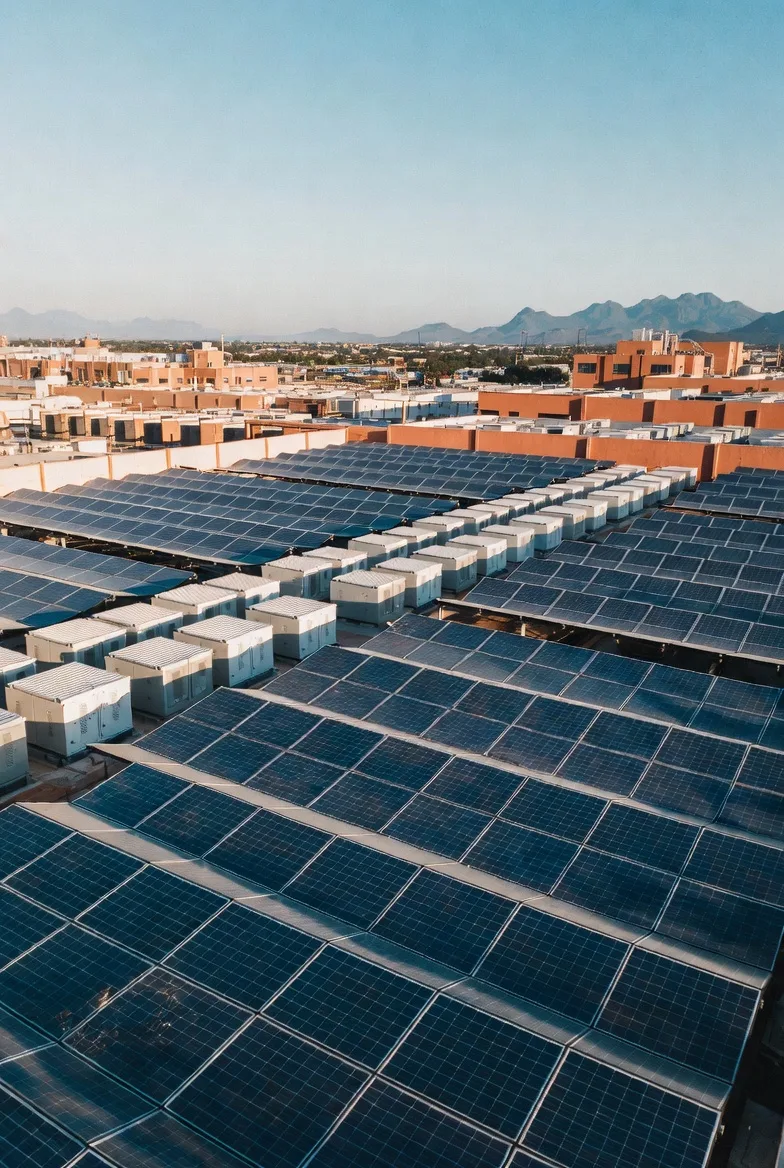
Portfolio-scale on-site generation and storage for industrial plants across the Bajío.
Let's discuss your projectWe mapped 73 German-owned companies with identifiable sites across Guanajuato, Querétaro, Aguascalientes and San Luis Potosí. Most of them are not offices. They are paint shops, forges, rubber-curing lines, glass furnaces and plastic extrusion halls, and many run more than one shift. The two German OEMs in the region, Volkswagen Silao and BMW San Luis Potosí, already run on renewable power. Among the suppliers around them, we found almost no public record of on-site generation.
By our estimate, the fifty-one plants with the clearest commercial fit represent roughly 64–183 MWp of on-site solar and US$52–216 million of capex for solar, storage and efficiency. The average project is only about US$2.6 million. That is too small for traditional project finance and too large to ignore, so capturing it takes aggregation. Mexico’s 2025–26 electricity rules have made that aggregation possible.
Why look at German industry at all?
Germany is one of the most important sources of industrial investment in the Bajío. State and chamber figures put the count at around 54 German companies in Guanajuato, 200 or more in Querétaro, 38 in San Luis Potosí and 16 in Aguascalientes. Together they represent several billion dollars of accumulated investment and tens of thousands of jobs.
From an energy-infrastructure point of view, three features make this group unusual:
- Credit quality. The local plants belong to Continental, Bosch, ZF, Schaeffler, Henkel, BASF, Bayer, Siemens and similar groups. A long-term energy contract with that kind of counterparty is about as bankable as Mexican distributed generation gets.
- Commitments already made. Most German parents have group-level climate targets. Bosch has been carbon-neutral for Scope 1 and 2 since 2020, and Schaeffler is targeting climate neutrality by 2040. What is usually missing is local execution, and that gap is where projects come from.
- Density. These plants cluster around Puerto Interior and Las Colinas in Silao, the Parque Industrial Querétaro and El Marqués corridor, the industrial zone of San Luis Potosí, and Villa de Reyes around BMW. That clustering matters for engineering, for O&M costs and, as we explain below, for regulation.
Where the energy actually goes
The most common mistake in C&I energy sales is to treat every plant as a roof. The German industrial base in the Bajío is not a roof market. It is a process-heat and demand-charge market that happens to have large roofs. By company type:
Automotive Tier 1 and Tier 2 suppliers (41 of 73)
This is the heart of the base and the main source of energy demand. The relevant processes are:
- Paint and E-coat lines. These are the largest thermal load in an auto-parts plant. Brose’s Aeropuerto plant in Colón, Querétaro covers 147,000 m² and includes stamping, welding and a paint shop. KIRCHHOFF Automotive’s new plant in San José Iturbide runs an E-coat line.
- Forging and heat treatment. Hirschvogel melts and forges aluminium in San Juan del Río. KAMAX cold-forges, heat-treats and plates high-strength fasteners in León. Schaeffler grinds and heat-treats bearings in Irapuato.
- Rubber curing. Continental’s tire and ContiTech plants in San Luis Potosí run curing presses and steam systems that employ more than 3,000 people between them.
- Plastic injection and extrusion. Examples include Fränkische in Silao, Grammer in Querétaro, and Kromberg & Schubert across Irapuato and San Francisco del Rincón.
Industrial automation, electrical and machinery (9)
This group includes the regional leaders in decarbonisation. Siemens installed on-site solar at its Querétaro plant in 2022. Siemens Energy commissioned rooftop PV there in February 2024 and has a target of 100% renewable electricity by 2030. Newer plants from Phoenix Contact in El Marqués and Bosch Rexroth in Querétaro show how the next generation of German investment is arriving: large, modern buildings with no legacy energy contract.
Chemicals, lubricants and materials (9)
This group is dominated by medium-temperature process heat: blending kettles, heated tank farms, reactors and compounding extruders. Henkel’s adhesives plant in Salamanca stands out because it holds ISO 50001 energy-management certification, the first Henkel adhesives plant in Latin America to do so. Fuchs is building a new lubricants plant on five hectares at WTC San Luis Potosí 2. Klüber Lubrication blends in the Parque Industrial Querétaro.
Pharma packaging (1)
Gerresheimer converts and anneals pharmaceutical tubular glass in Querétaro. Its process is continuous and high-temperature, like much of the glass sector, which is hard to decarbonise. At sites like this, heat recovery and electrification can be worth more than panels.
Food, consumer and agribusiness (4)
Dr. Oetker’s Querétaro plant produces 250 tonnes per day and already runs a solar park covering 25–30% of its annual consumption. It is one of the clearest demonstrations in the region that German manufacturers will invest capital in their own generation. Bayer’s seed-conditioning plant in Villagrán has a large, strongly seasonal drying load. Seasonal assets like this need a different product from a flat power-purchase agreement.
Logistics and warehousing (5)
These sites use very little process energy but have very large roofs. DHL’s national hub at Querétaro Intercontinental Airport is LEED Silver and has 610 solar panels. It is the local proof that logistics roofs are an easy win.
Aerospace (1)
Diehl Aviation opened the first Diehl factory in the Americas in El Marqués: 600 people and an investment of MXN 918 million.
The OEMs are not the market. They are the reason the market moves.
The two big German OEMs in the region have already solved their own electricity problem:
- Volkswagen Silao produces its engines with renewable energy and has a carbon-neutral production target for 2030.
- BMW San Luis Potosí runs on 100% renewable electricity. It has 28.3 MWp of on-site solar across 71,000 m² and is expanding toward 140,000 m².
That does not make them customers. It makes them the reason their suppliers will take the conversation seriously. When a Tier 1 ships into a plant with a carbon-neutral target, the supplier’s emissions become part of the OEM’s Scope 3. This gives suppliers a reason to act before their own electricity bill forces them to.
One further change is worth noting. COMPAS, the Mercedes-Benz and Nissan joint venture in Aguascalientes, closed on 31 May 2026. It was the largest German-linked industrial load in that state. Any Bajío energy map drawn before late 2025 is already out of date.
Sizing the opportunity
No company in the four states publishes site-level consumption. We therefore sized the market with a deliberately simple method and report ranges rather than point estimates.
Step 1: Group plants by observable scale.
| Band | Rule | On-site PV per site |
|---|---|---|
| Anchor | ≥1,500 employees, or ≥80,000 m² | 3–8 MWp |
| Core | 400–1,499 employees, or 20,000–80,000 m² | 1–3 MWp |
| Volume | 100–399 employees, smaller sites, warehouse roofs | 0.3–1 MWp |
Step 2: Price the capacity. The Mexican commercial benchmark is MXN 18,000–24,000 per installed kWp for systems up to about 330 kWp. We applied USD 0.70–1.20/Wp depending on system size, with lower costs at MW scale. Where the load profile justifies storage, we added it at US$300–400/kWh.
Step 3: Apply the method to the 51 plants with the clearest commercial fit. We excluded the OEMs, closed sites and plants we could not verify.
| Measure | Estimate |
|---|---|
| On-site solar | 64–183 MWp (central estimate ~124 MWp) |
| Storage, where the load profile justifies it | 12–99 MWh |
| Capex for solar and storage | US$52–216 million (central estimate ~US$134 million) |
| Average project | ~US$2.6 million, ~2.4 MWp |
These figures are modelled, not measured. About a third of the plants do not publish their scale, so we inferred it from process type. Roof structural capacity, available land and existing supply contracts will all reduce these numbers, and none of them will increase them. Read these figures as an upper-bound estimate of the opportunity, not a forecast.
This is also only the German subset. The same parks host Japanese, American, Spanish and Mexican manufacturers with similar processes. The German plants are a well-documented starting point, not the ceiling.
The real finding: this is an aggregation market
The most important number in the table is the last one. An average project of US$2.6 million is too small for conventional project finance, where transaction costs are fixed and a single deal needs to be large to justify them. It is also far larger than a small business installing panels on a shop roof.
This market sits between the two, and it only works with a different operating model:
- Standardised documentation. One contract template, one technical specification per band, and one insurance and O&M package, reused rather than renegotiated.
- Portfolio origination. Many similar assets with strong corporate counterparties, originated as a pipeline rather than one project at a time.
- Process engineering up front. A glass plant needs a heat-recovery conversation, not a panel quote. A stamping plant needs peak shaving. If the proposal does not fit the process, it gets treated like a commodity installer’s quote.
The regulation finally fits the market
Mexico’s electricity rules were rewritten over 2025 and 2026. For this segment, the changes help.
| Capacity | Regime | Permit |
|---|---|---|
| Below 0.7 MW | Distributed generation (generador exento) | None. Interconnection is handled with the distributor |
| 0.7–20 MW, interconnected | Autoconsumo | Simplified CNE permit |
| Above 20 MW, or isolated | Autoconsumo | Standard CNE procedure |
| Up to 5 MW | Micro-grid (isolated modality) | Structured route |
Two changes matter most:
- The exempt threshold rose from 0.5 MW to 0.7 MW, a 40% increase in what a plant can install without a generation permit. For the smaller band of plants, most projects now avoid the permitting step entirely.
- Group autoconsumo has been formalised. Rules issued by the CNE on 28 November 2025 created a registry, registration requirements and a standard CFE contract for selling surplus energy. Several sites in the same industrial park can now operate under one registered arrangement. That is the geography of Puerto Interior, Las Colinas, PIQ and El Marqués, and it is the mechanism that turns a set of US$2–3 million assets into a portfolio that can be financed.
What could go wrong
This thesis has clear risks.
- Concentration. Most of the demand base belongs to a single supply chain. A tariff shock, a delayed model launch or another plant closure would affect many sites at once. COMPAS shows this is not hypothetical.
- Roofs. Older plants often cannot support the nominal rooftop capacity. A structural survey is the first real diligence step, not a formality.
- Data. No plant in the region publishes shift patterns or consumption. Every load profile in this article is a hypothesis that a 30-minute conversation with a plant engineer can confirm or disprove.
- Nationality. Some companies commonly described as “German” in Mexican industrial press are not German-controlled. For example, DB Schenker now belongs to DSV (Denmark), HELLA is majority-owned by FORVIA (France), and Grammer is controlled by Ningbo Jifeng (China). Getting this wrong in a German-capital conversation costs credibility.
Summary
| Question | Answer |
|---|---|
| How big is the German industrial base? | 73 companies with identifiable sites mapped in four Bajío states; state counts suggest several hundred in total. |
| Where does the energy go? | Paint and E-coat, forging and heat treatment, rubber curing, glass, plastic extrusion. It is mainly thermal and often runs more than one shift. |
| Who has already moved? | VW Silao, BMW SLP, Siemens, Siemens Energy, Dr. Oetker and DHL Querétaro. Among suppliers, we found few public records of on-site generation. |
| How large is the opportunity? | ~64–183 MWp and US$52–216 million (modelled) across 51 plants with a clear fit. |
| What kind of market is it? | An aggregation market with an average project of ~US$2.6 million. It needs standardised, portfolio-scale origination. |
| What changed? | The permit-exempt limit rose to 0.7 MW, and group autoconsumo now lets several sites in one park aggregate. |
If you manage energy at an industrial site in the Bajío, or you finance distributed generation in Mexico and want to discuss portfolio-scale structures, we would like to hear from you. Get in touch.
Company facts come from company announcements, state investment agencies and Mexican industrial press (Mexico Industry, Cluster Industrial, El Financiero, El Universal, Forbes México, Somos Industria, Líder Empresarial). Model inputs and regulatory references are listed below.
Sources: PSE Energía — commercial solar cost, MXN 18,000–24,000/kWp (2026) · Energías Limpias — distributed-generation limit raised to 0.7 MW · Energía Real — autoconsumo and group autoconsumo, CNE, 28 Nov 2025 · KUNETIC — C&I battery storage cost, 2026 · Automotive Manufacturing Solutions — BMW San Luis Potosí solar · El Universal — Volkswagen Silao · Mexico Industry — Siemens Energy Querétaro · Mexico Industry — Dr. Oetker Querétaro · El Financiero — COMPAS closure
Portfolio-scale on-site generation and storage for industrial plants across the Bajío.
Let's discuss your projectThis article is also available in Spanish. Read in Spanish