Infrastructure
Hydrogen in Mulegé: why isolated grids may become Mexico's greenest
CFE is building its first solar, battery and green-hydrogen project in Mulegé. It is no accident: small, isolated power systems are the ones that can decarbonise fastest, and that is SENER's reasoning.
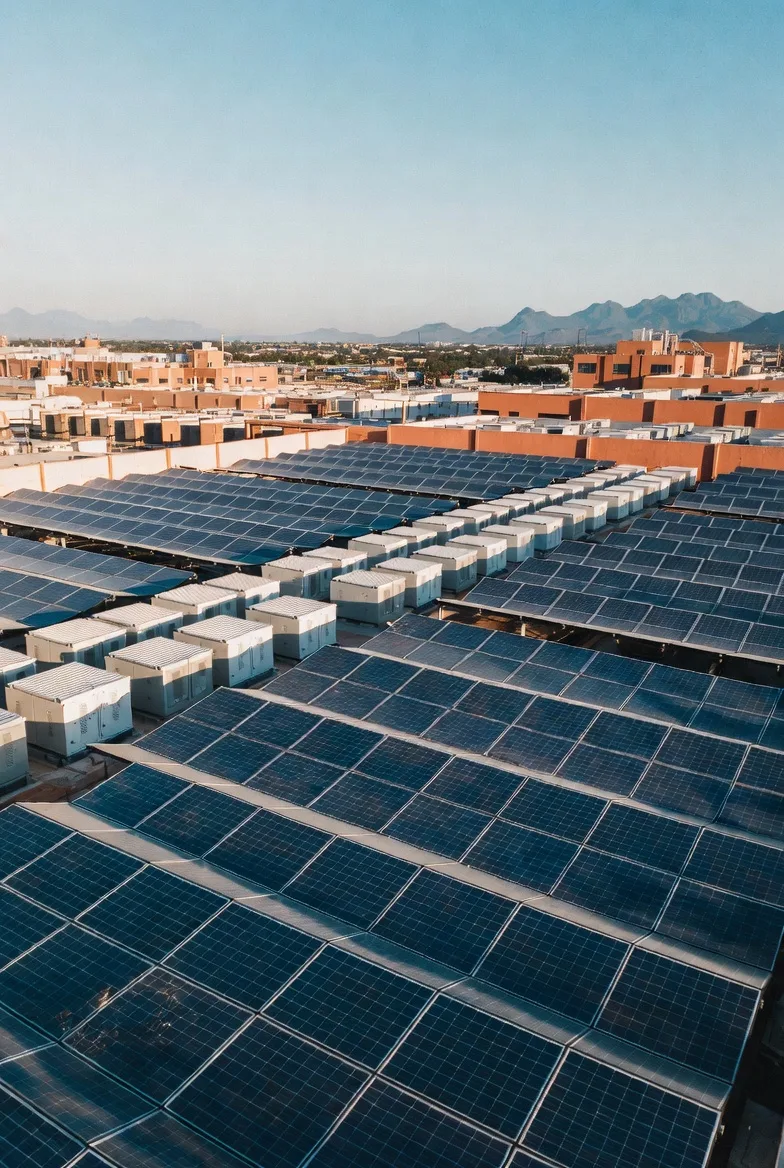
Behind-the-meter generation and storage for industrial plants across the Bajío.
Let's discuss your projectBajío Ventures · September 2026
CFE’s first green-hydrogen project is not in the Bajío or the industrial north. It is in Mulegé, Baja California Sur, one of the smallest power systems in the country. It is called Project Oasis, and it follows a logic SENER has already written into its planning: small, isolated systems are the ones that can become Mexico’s greenest.
Mexico’s power systems
Mexico does not run a single grid. It runs four power systems: the National Interconnected System (SIN), Baja California, Baja California Sur and Mulegé. Baja California operates in sync with the western United States and in 2026 gained a first 300 MW link to the national grid. Baja California Sur and Mulegé remain isolated: they depend on diesel and fuel oil delivered by ship or truck. That makes them the natural candidates to decarbonise first. (The full map of systems, control areas and regions is in Mexico’s electrical regions.)
Project Oasis
Oasis combines solar generation, batteries and green hydrogen on an isolated grid. The figures CFE has released:
- Capacity: 60 MW of solar and 20 MW of storage, per the September announcement. A July report cites 72 MW of solar, 20 MW of batteries, 20 MW of electrolysis and 6 MW of fuel cells; the final configuration has not been published.
- Hydrogen: according to CFE, it will allow a progressive blend of hydrogen and natural gas in turbines that currently accept up to 30% hydrogen.
- Impact reported by CFE: 23,000 m³ of diesel and fuel oil avoided per year and more than 93,000 tonnes of CO₂; supply for 40,000 households and 120 m³ of water delivered to the local population.
Why there? Mulegé faces particular fuel-supply problems: it is electrically isolated and its geography makes it hard to bring in natural gas. Today it is served by six small plants — two gas turbines, one internal-combustion unit, one geothermal, one wind and one solar — with a firm base that is still fossil, and it has suffered blackouts.
Hydrogen in long-term planning
The Electricity Sector Development Plan (PLADESE) includes hydrogen on two fronts:
- National Interconnected System: 3,668 MW of combined-cycle capacity running on a 75% natural gas / 25% hydrogen blend between 2036 and 2038.
- Baja California Sur: technology with hydrogen as the primary fuel, alongside 350 MW of central-tower concentrated solar power.
Why isolated grids can be the greenest
- They are small. A few projects move the percentage a lot. Mulegé’s 60 MW or BCS’s 350 MW of CSP shift the needle more than thousands of MW on the national system.
- Their alternative is expensive. Where trucked-in diesel or fuel oil is burned, solar plus storage competes immediately, even at a higher cost per installed MW.
- They need firm power at night. That is why they get the most innovative technology: molten-salt CSP, batteries and hydrogen.
Baja California: the exception
Baja California also runs separately from the national system and has a significant clean base: the Cerro Prieto geothermal field, with 720 MW installed and about 570 MW operating. Yet the paradox remains. The state exports its wind to California and has just added a gas-fired combined cycle, the 745 MW González Ortega plant in Mexicali. It is not heading in the same direction as BCS and Mulegé. (More context in Baja California in 2026.)
The lesson for industry
The logic of isolated grids applies to industrial parks on weak grids. Where the alternative is expensive (backup diesel, outages, demand penalties), solar with batteries pays back faster. It is Mulegé’s argument at plant scale.
Sources: La Jornada, CFE’s Oasis green-hydrogen project, 10 Sep 2026 · Expansión, “CFE launches Oasis”, 3 Jul 2026 · Energy21, CFE prepares green-hydrogen project in Mulegé · SENER, PLADESE, ch. 4 · Factor Energético, SENER’s binding plan · La Jornada, Cerro Prieto, 28 Jun 2026 · CFE, commercial operation of the González Ortega CC, May 2026
Bajío Ventures, operating under the Bajío Invest brand, is a Mexican energy infrastructure investment group based in Guanajuato: capital, a data platform on the regional industrial base and a German industrial channel, with its own advisory presence in Berlin.
Behind-the-meter generation and storage for industrial plants across the Bajío.
Let's discuss your projectThis article is also available in Spanish. Read in Spanish