Infrastructure
The line that already exists: what a 67 km reconductoring in Baja California shows about grid capacity in the Bajío
At EnerBaja 2026, Covanaro presented the reconductoring of the 115 kV Cañón–San Quintín line: a new conductor on an existing line, with no new right-of-way and no loss of supply to San Quintín.
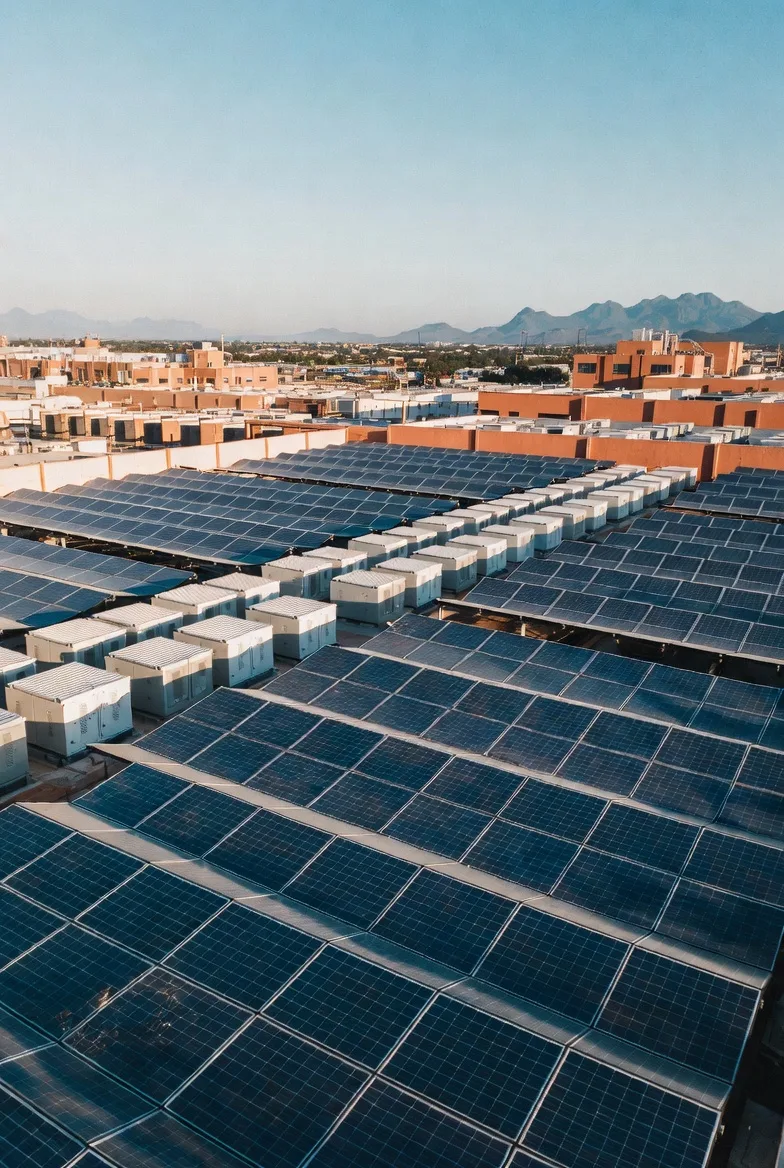
Behind-the-meter generation and storage for industrial plants across the Bajío.
Let's discuss your projectBajío Ventures · September 2026
At EnerBaja 2026, Covanaro Obras Electromecánicas presented a project that deserves more attention than it usually gets. It is not a new power plant or a new transmission line. It is a new conductor on a line that already exists.
The corridor
The Cañón–San Quintín line is a 115 kV radial corridor, 67.12 km long, carried on 251 wood H-frame structures. It is the only supply path to San Quintín, a municipality whose economy rests on export agriculture, fishing, aquaculture, tourism and a growing industrial base. Over the years the line had accumulated two different conductors: 266 kcmil and 477 kcmil ACSR. The thinner sections set the limit for the whole circuit.
What changed
Covanaro is replacing both with a single high-temperature conductor, ACSS-AW 336 kcmil. The difference is in the materials rather than the size:
- In conventional ACSR, the hard aluminum both conducts and carries part of the mechanical load, and the rated temperature is 75 °C.
- In ACSS, the aluminum is annealed and only conducts. The core, aluminum-clad steel, carries the tension, and the conductor is rated up to 200 °C.
The published figures are 957 A at 200 °C, against 660 A for the 477 ACSR at 75 °C, and 656 kg/km against 975.8 kg/km. The new conductor is a third lighter, which is why most of the existing structures stay in place. Measured against the 266 sections that used to limit the line, the thermal capacity of the corridor roughly doubles.
The scope has six items:
- Removal of the old conductors.
- Installation of the new conductor.
- New insulation.
- Repairs to suspension and dead-end structures.
- New structures and tapered steel poles at specific points.
- New connections at both substations.
Keeping San Quintín supplied
A radial line cannot simply be switched off for months. Covanaro built a temporary, energized 115 kV line on single wood poles, 8.5 m from the line under construction. Both lines fit inside the existing right-of-way of about 35 m. No new easements were needed, and the region stayed supplied while the permanent line was rebuilt.
Stringing is done in sections of about 5 km. The conductor runs through large sheaves lined with neoprene or urethane and never touches the ground, because annealed aluminum is soft and scratches turn into hot spots at high temperature. After stringing, the conductor rests for 24 hours before it is sagged.
What the conductor alone does not solve
Covanaro closed with a sentence worth repeating: added capacity only creates value when the whole line can operate it safely. A new conductor does not upgrade the breakers and switches at each end. It does not remove the voltage drop on a long radial line. And it does not create a second supply path. San Quintín now has more capacity, but it is still fed by a single line.
Why this matters in the Bajío
We have written about why the Bajío: most companies in the region’s industrial parks report electricity supply problems. We have also written about why permitting is no longer the problem: generation tenders have been declared void because the grid is saturated. In the Bajío, the scarce resource is increasingly the corridor, not the megawatt.
San Quintín shows that part of that capacity may already be standing, in lines built decades ago with conductors specified for other loads. It also shows the conditions under which it can be recovered: a clear right-of-way, structures that can carry the load, and terminal equipment sized to match.
Acknowledgement. Bajío Ventures thanks Ing. Alejandro Villafuerte Leal, Project Manager at Covanaro, and the whole Covanaro team for presenting this case at EnerBaja 2026 with an uncommon level of technical detail, and for sharing the field experience that gave rise to this note.
Bajío Ventures — a Mexican energy-infrastructure investment group based in Guanajuato: capital, a data platform on the region’s industrial base, and a German industrial channel, with its own advisory presence in Berlin.
Behind-the-meter generation and storage for industrial plants across the Bajío.
Let's discuss your projectThis article is also available in Spanish. Read in Spanish