History
The Mexican Central Railway: the line that made the Bajío
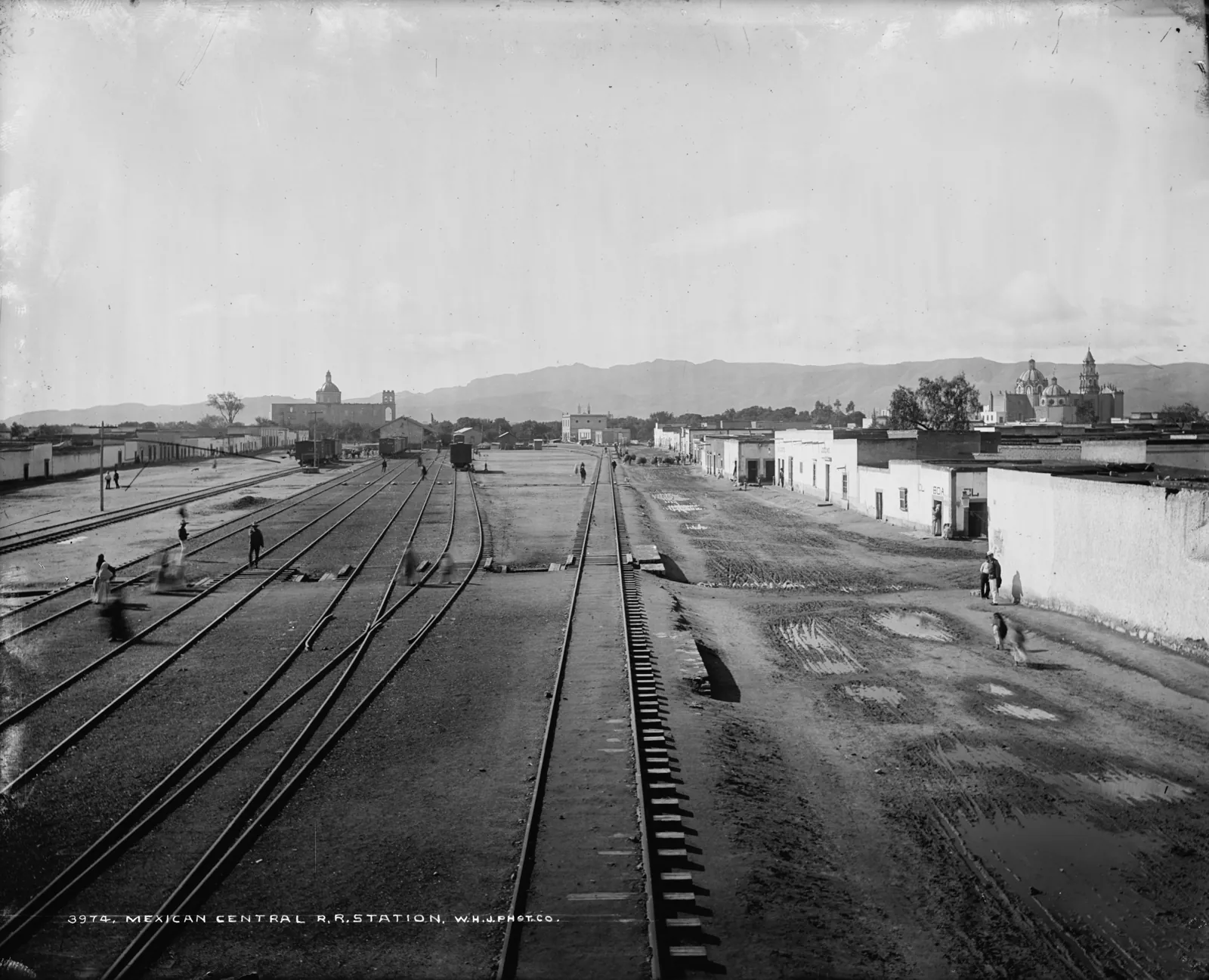
In March 1884 the Mexican Central tied Mexico City to the border at El Paso along the old Camino Real. Irapuato became a junction, and the station towns of that era are today's industrial cities.
Origination and structuring of USD 5–50 million infrastructure projects across the Bajío.
Let's discuss your projectBajío Ventures · February 2026 · Rails of the Bajío, 1 of 6
The new passenger line from Mexico City to Querétaro and Irapuato rebuilds, 140 years later, the corridor that the Mexican Central Railway laid in 1884. Same valleys, same cities, same logic: tie the capital to the Bajío’s farms and factories and to the U.S. border. This series follows that line from the first rails to the first trains, and asks one question throughout: what does it mean for investment in Guanajuato?
1884: the capital, by rail to the border
In March 1884 the Mexican Central opened its main line from Mexico City to Paso del Norte (today Ciudad Juárez), across the river from El Paso. The company was incorporated in Massachusetts in 1880 and connected at the border to the Southern Pacific, the Texas and Pacific, and the Santa Fe (Wikipedia). For the first time, the capital was on a continuous rail line to the U.S. market.
The route
The line did not invent a corridor; it followed the colonial Camino Real de Tierra Adentro, the silver road. From the Valley of Mexico it ran north through Querétaro, then west across the Bajío plain — Celaya, Salamanca, Irapuato, Silao, León — before climbing to Aguascalientes, Zacatecas and Chihuahua. Guanajuato capital hung off the main line on a short branch from Silao, because the mining city sits in a canyon, not on the plain.
Two branches made Irapuato a junction. Irapuato–Guadalajara was completed in 1888, and Guadalajara–Manzanillo in 1908; eastward, Chicalote–Tampico opened in 1890 (Wikipedia). The Bajío became a cross: north–south to the border, east–west from the Gulf to the Pacific.
The logic
- Geography. The Bajío is the flattest, lowest gap in the central highlands. Rail is cheapest where gradients are gentle, so the line went where the land let it.
- Cargo. Silver and ores from Guanajuato and Zacatecas, grain from the plain, textiles from Querétaro and León. The railway turned a region of mule trains into a region of freight yards.
- Market. American capital built it to reach American buyers. By 1902 the company advertised that Guanajuato, León, Querétaro, Irapuato and Celaya were on its line (1902 advertisement, archive.org).
- State. Porfirio Díaz paid subsidies per kilometre. The network grew from about 640 km when he took office to about 24,700 km by 1910 (Wikipedia).
What it left behind
The station towns became today’s industrial cities. Irapuato grew as the junction; Celaya and Salamanca as stations on the plain; León as the terminus of a manufacturing hinterland. When highways came in the 20th century (Federal 45, then 45D), they were laid alongside the rails. Every industrial park on the corridor today sits within a few kilometres of the 1884 alignment.
The price was also real. Historians record displacement and land concentration along the line; the railway accelerated growth and inequality at the same time. In 1909 the Díaz government took majority control of the main lines, including the Central, through the new Ferrocarriles Nacionales de México (Wikipedia).
For investors: the corridor is 140 years old. New infrastructure in the Bajío rarely creates geography; it re-prices it.
In this series: 1. The Mexican Central Railway · 2. A century without passenger trains · 3. The new Mexico City–Querétaro–Irapuato train · 4. Guanajuato’s stake · 5. First trains (coming soon) · 6. Beyond Irapuato (coming soon)
Bajío Ventures is a Mexican energy infrastructure investment group based in Guanajuato. We originate and structure USD 5–50 million projects across the Bajío corridor.
Image: photograph by William Henry Jackson, U.S. Library of Congress (no known restrictions on publication).
Sources: Wikipedia — Mexican Central Railway · Wikipedia — Rail transport in Mexico · West American Scientist, 1902 — Mexican Central advertisement (archive.org)
Origination and structuring of USD 5–50 million infrastructure projects across the Bajío.
Let's discuss your projectThis article is also available in Spanish. Read in Spanish