Infrastructure
2027: the year Mexico's power system will be tightest
CFE projects the system's reserve margin at 13.2% in 2027, its low point before new capacity arrives. An industrial plant has months, not years, to prepare.
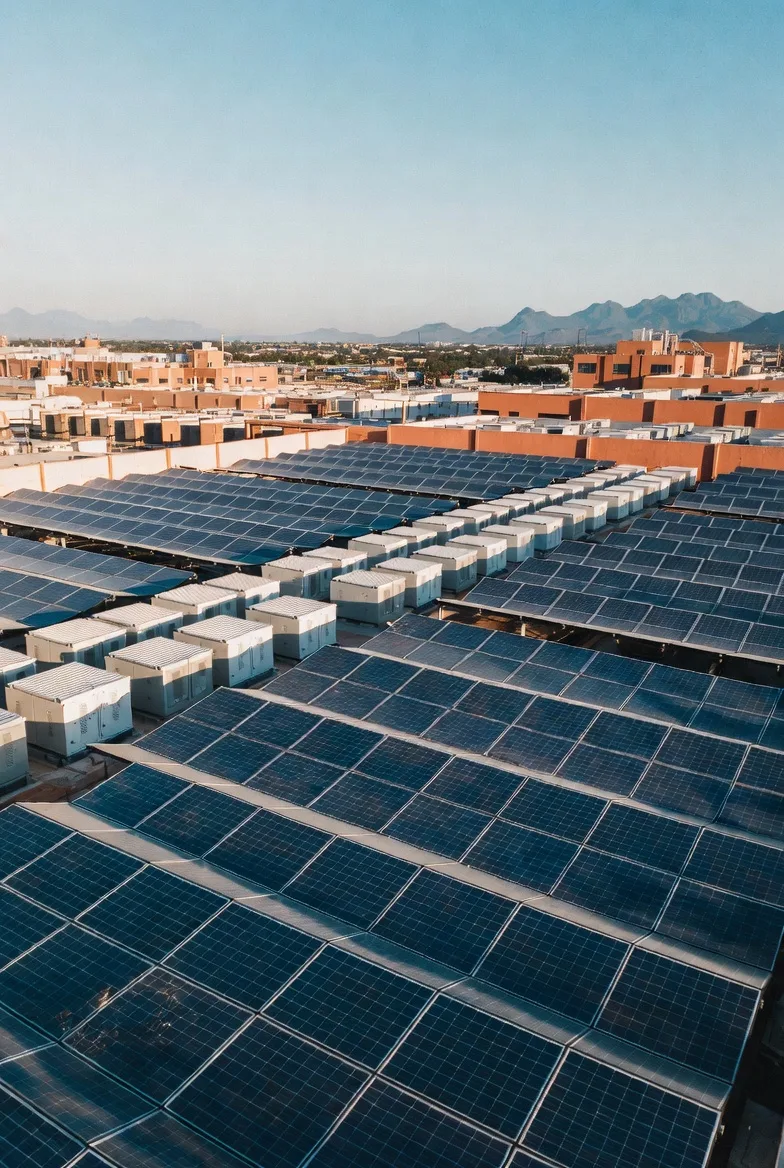
On-site storage and generation for industrial plants in the Bajío, ready before summer 2027.
Let's discuss your projectBajío Ventures · September 2026 · CFE’s plan, read from the Bajío, 2 of 3
Among the slides CFE showed at EnerBaja 2026 was a figure that went almost unnoticed: the projected reserve margin of the National Electric System.
| 2026 | 2027 | 2028 | 2029 | 2030 |
|---|---|---|---|---|
| 14.8% | 13.2% | 17.0% | 21.2% | 24.2% |
Source: CFE, 2025–2030 Strengthening and Expansion Plan, EnerBaja 2026.
2027 is the low point
The margin falls before the new combined-cycle plants and the Mixed Development Scheme projects come online. The recovery afterwards is strong, but it depends on projects arriving on time, and in infrastructure of this size delays are the norm. The PLADESE 2025–2039 schedules 28,004 MW of new capacity between 2025 and 2030, according to Mijares’ summary; every plant that slips pushes the trough beyond 2027.
CFE’s finances show the same pattern. Its projected EBITDA grows only 2.7% in 2027 and jumps 16% in 2028, when the new capacity arrives. The physical and the financial figures point to the same year.
What a low margin means
- More hours in an operating alert state during summer peaks. The system has been there: on 7 May 2024 CENACE declared an emergency state with rolling load shedding, and in 2025 it again strung together days of alert.
- High short-term market prices in critical hours.
- Greater risk of regional constraints. A 13% national margin can hide much tighter zones, and the industrial Bajío is a candidate, because the grid is the bottleneck.
What an industrial plant can do today
- Measure its load profile by interval and know how much it draws in peak hours.
- Evaluate battery storage (BESS) to shave peak demand and back up critical processes.
- Review its supply strategy and hedge price before 2027, not during it. We reviewed the schemes available in 2026.
- Prepare demand response: identify which loads can shift without affecting production.
A storage or on-site generation project takes 9 to 18 months to design, permit and install. To be ready for summer 2027, the decision has to be made in the coming months.
In this series: 1. The bottleneck is the grid · 2. 2027, the tightest year · 3. National content: the opportunity Mexico is letting slip
Sources: CFE, 2025–2030 Strengthening and Expansion Plan, EnerBaja 2026 presentation · DOF, SENER decree issuing the PLADESE · Mijares, SENER issues the PLADESE 2025–2039 · El Financiero, timeline of 7 May 2024 · Energy Magazine, CENACE in operating alert state
Bajío Ventures — a Mexican energy-infrastructure investment group based in Guanajuato: capital, a data platform on the region’s industrial base, and a German industrial channel, with its own advisory presence in Berlin.
On-site storage and generation for industrial plants in the Bajío, ready before summer 2027.
Let's discuss your projectThis article is also available in Spanish. Read in Spanish