Regulation
24 months: the real interconnection timeline
From application to commercial operation takes 22 to 26 months in the best case. And your place in the queue isn't won when you apply — it's won when you sign.
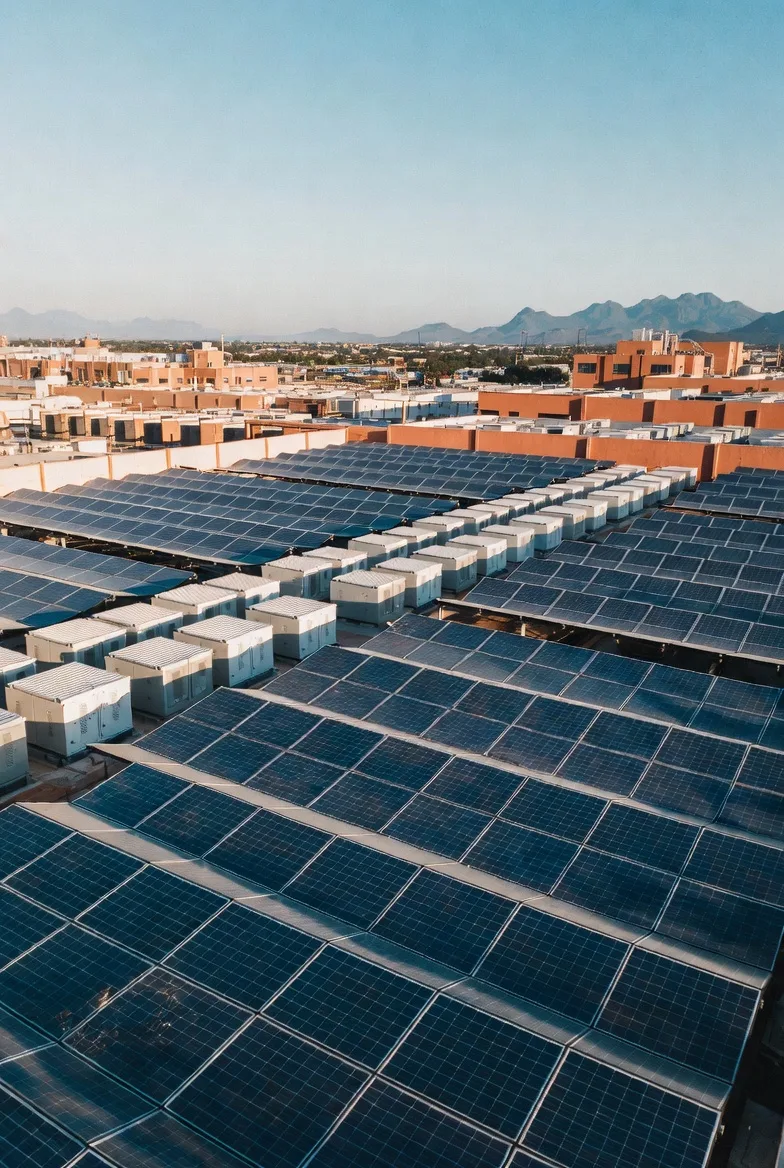
Readiness review before applying for interconnection: land, permits, models and guarantees.
Let's discuss your projectBajío Ventures · May 2026 · Grid First, 2 of 4
Added up, the reference timelines of the interconnection and connection process give a number every financial model should include: 22 to 26 months from application to commercial operation, if nothing slips.
The stages
| Stage | Reference timeline |
|---|---|
| Studies, up to the contract | ~90 business days (4–5 months); varies with capacity |
| Engineering | 5–6 months |
| Construction, testing and commercial operation | 12–16 months |
The process applies to power plants and to load centers of 1 MW or more connecting at 69 kV or above: industrial parks and residential, commercial and agricultural developments. It also applies to increases in contracted load. Below 69 kV, the connection goes through the distributor.
Your place in the queue is won at signing
Queue priority is acquired when the interconnection or connection contract is signed, not when the application is filed. To sign, CENACE requires, among other things:
- Valid studies and the letter accepting them.
- A CNE generation permit, for power plants.
- Documents proving ownership or possession of the site.
- The originals of the financial guarantee instruments.
A project without its land secured or its permit in process can finish the studies and still lose its place. The contract itself has a new format: the CNE published the model interconnection and connection contract, which covers storage and load centers, in the DOF on March 17, 2026.
Models are on the critical path too
CENACE requires mathematical models of the plant or load and its controls, in tools such as PSS/E or EMTP-RV. Those models come from the inverter or plant-controller manufacturer. If they aren’t required from the moment the equipment is purchased, the project stalls at the study stage.
Recommendation
Treat interconnection as the critical path from day one:
- Run the permit and the studies in parallel.
- Secure the site before signing.
- Write model delivery into the equipment supply contract.
- Keep the EPC contractor accountable through commercial operation.
CENACE publishes a cost and timeline calculator worth checking before budgeting. In the next installment we look at when the grid that will be needed gets decided.
In this series: 1. Who decides what on Mexico’s power grid · 2. 24 months: the real interconnection timeline · 3. The Bajío’s grid is decided in June · 4. What Baja California teaches the Bajío
Sources: Manual for the Interconnection of Power Plants and Connection of Load Centers (DOF, Feb 9, 2018) · CENACE, cost and timeline calculator · CENACE, SIASIC: process requirements · DOF, model interconnection and connection contract (Mar 17, 2026) · Greenberg Traurig, new model contract (Apr 2026)
This content is for information only and does not constitute legal, regulatory or investment advice. Timelines are for reference; each project’s depend on its capacity, modality and connection point.
Bajío Ventures — a Mexican energy-infrastructure investment group based in Guanajuato: capital, a data platform on the region’s industrial base, and a German industrial channel, with its own advisory presence in Berlin.
Readiness review before applying for interconnection: land, permits, models and guarantees.
Let's discuss your projectThis article is also available in Spanish. Read in Spanish