Regulation
What Baja California teaches the Bajío
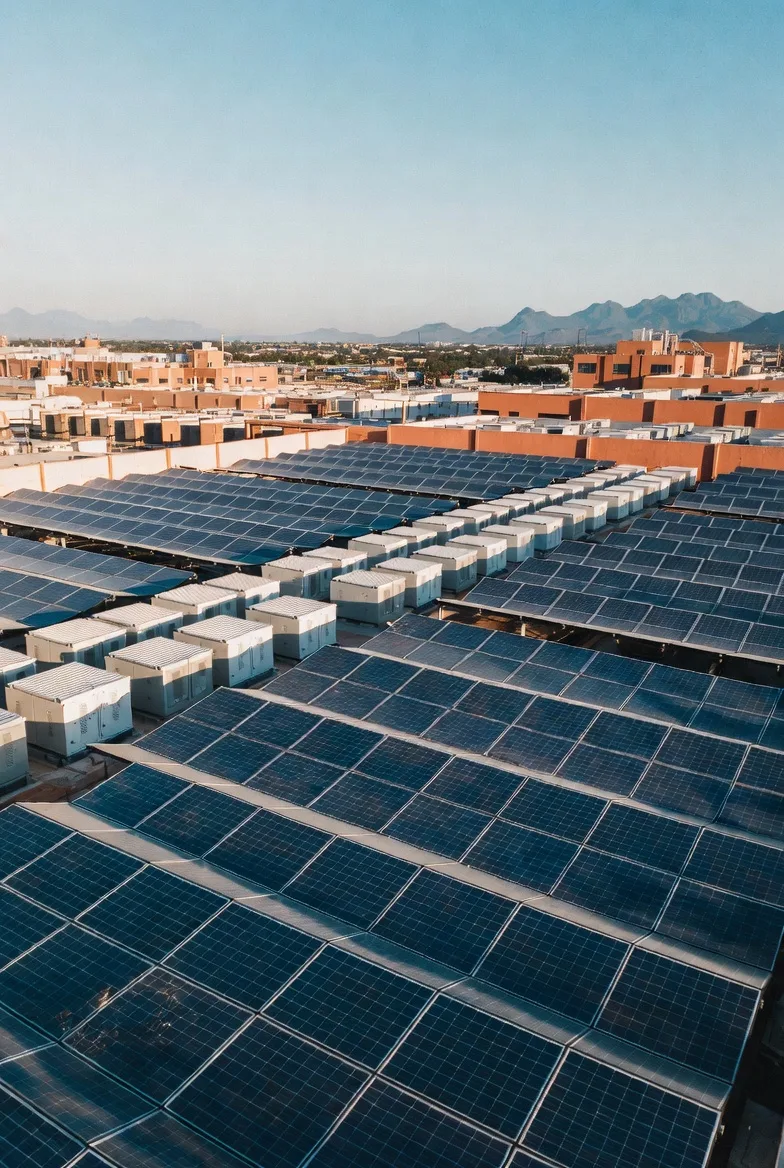
Baja California is a small system, isolated from the rest of the country and synchronized with California. That's why it hits, early, the problems the rest of Mexico will face within a few years.
Technical criteria for bankable projects: models, dynamic studies and grid-forming storage.
Let's discuss your projectBajío Ventures · May 2026 · Grid First, 4 of 4
Baja California is a small system, isolated from the rest of the country and synchronized with California. That’s why it hits, early, the problems the rest of Mexico will face within a few years.
The duck curve reaches small grids first
As solar generation grows, the demand dispatchable plants must cover drops sharply in the morning and climbs abruptly in the evening, when the sun sets and the peak arrives. In an isolated system that ramp can’t be shared with the rest of the country: it is covered by local plants and storage, or by imports from California. The storage being installed today is sized for energy; the ramp also demands power and fast response.
The problem isn’t just energy — it’s stability
For system operators, inverter stability is already the main challenge. International experience shows why:
- In Texas, in May 2021, a normal grid fault triggered a 1,112 MW reduction in solar output at plants up to 200 miles away.
- In the eastern United States (Northern Virginia, per press reports), in July 2024, about 1,500 MW of data center load disconnected at once after a series of faults on a 230 kV line.
Data centers, air conditioning and batteries change how the grid responds within milliseconds. That’s why traditional studies are no longer enough, and electromagnetic transient (EMT) studies and validated control models are being required.
Regulation has already moved
On April 16, 2026, the CNE published in the DOF the rules for integrating storage systems into the National Electric System. Among other points, they require grid-forming technology from power-electronics-based systems that inject into the transmission or distribution grid, with no capacity threshold.
Recommendation
For a Bajío project to be bankable in 2027–2030, megawatts and price are not enough. The file must demonstrate dynamic behavior:
- Validated models of the plant or load.
- EMT studies where the grid is weak or the load is sensitive.
- Disconnection and reconnection criteria for large loads.
- Grid-forming storage where applicable.
A project that arrives with this resolved moves faster through CENACE and gives capital more certainty.
In this series: 1. Who decides what on Mexico’s power grid · 2. 24 months: the real interconnection timeline · 3. The Bajío’s grid is decided in June · 4. What Baja California teaches the Bajío
Sources: NERC, Odessa disturbance report (2021) · NERC, simultaneous voltage-sensitive load reductions (Jan 2025) · DLA Piper, CNE storage guidelines (May 2026) · Greenberg Traurig, storage rules (May 2026) · IMCO, power system infrastructure (May 2025)
This content is for information only and does not constitute legal, regulatory or investment advice.
Bajío Ventures — a Mexican energy-infrastructure investment group based in Guanajuato: capital, a data platform on the region’s industrial base, and a German industrial channel, with its own advisory presence in Berlin.
Technical criteria for bankable projects: models, dynamic studies and grid-forming storage.
Let's discuss your projectThis article is also available in Spanish. Read in Spanish