Thesis
Industry 5.0: the 400 Gbps network, AI and the person at the centre
The coming factory moves more data in one shift than a factory of ten years ago moved in a month. That pushes the plant backbone from 10 to 100 and 400 Gbps, puts artificial intelligence on the floor, and forces work to be redesigned around the operator, not the other way round.
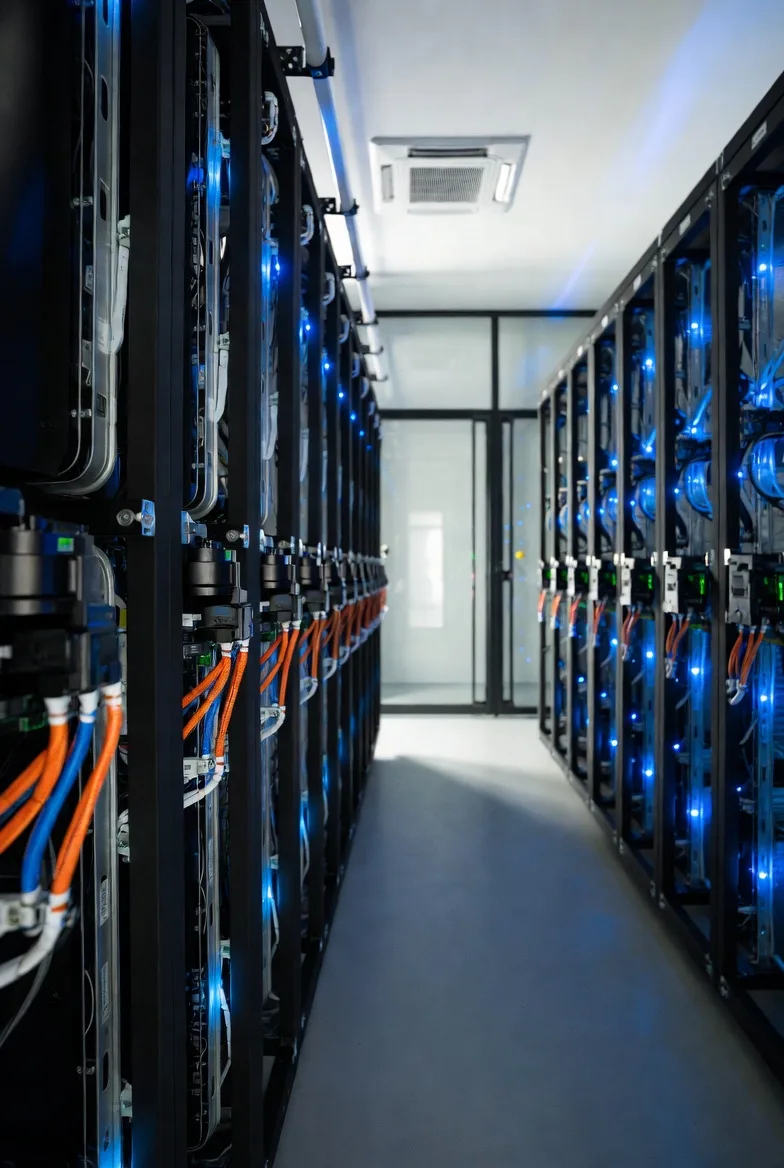
Energy, connectivity and infrastructure for industrial plants in the Bajío.
Let's discuss your projectBajío Ventures · June 2026
Industry 4.0 connected the machines. Industry 5.0, as the European Commission defined it in January 2021, does not replace it: it completes it with three demands — that industry be sustainable, resilient and human-centric, placing “the wellbeing of the industrial worker at the centre of the production process” with technology that “supports and empowers, rather than replaces, workers”.
Put that way it sounds like a statement of principles. In a plant it translates into three concrete things: a much thicker network, artificial intelligence on the floor, and a redesign of work. All three matter to anyone investing in infrastructure in the Bajío.
1. The network: from 10 to 100 and 400 Gbps
On the floor, the control network will stay modest: industrial Ethernet at 100 Mbps or 1 Gbps, increasingly with TSN (time-sensitive networking) so control remains deterministic. What changes is the plant backbone, the network linking the cells to the compute room.
The reason is machine vision. A 25-megapixel inspection camera at 8 bits per pixel and 150 frames per second generates about 30 Gbps on its own. A cell with eight such cameras produces 240 Gbps: it no longer fits in a 100 Gbps link, but it does fit in a 400 Gbps one. That is why cameras with native 25, 50 and 100 GigE interfaces exist for automated optical inspection.
Add to that the digital twin, which mirrors the plant in near real time, and AI servers that run inference on site so that not every image has to go to the cloud. The result is a three-tier architecture:
| Tier | What it connects | Typical speed |
|---|---|---|
| Field | PLCs, sensors, drives, robots | 100 Mbps – 1 Gbps, TSN |
| Cell | Cameras, inspection stations, edge | 10 – 25 Gbps |
| Plant backbone | Cells ↔ AI compute ↔ digital twin | 100 – 400 Gbps |
This is not experimental technology. The 400 Gbps standard (IEEE 802.3bs) was approved in December 2017, and AI data centres have already moved to 800 Gbps and are starting on 1.6 Tbps. What reaches the factory is mature equipment with falling prices.
2. AI: the factory that wastes less
Data is only worth something when it turns into decisions. Three cases with public figures:
- Schneider Electric, Monterrey. Recognised as a Lighthouse by the World Economic Forum in October 2024: about 30% less energy and water, manufacturing costs −16%, defects −20% and customer lead time −49% over three years, using machine learning for demand forecasting and deep learning in inspection.
- Siemens, Amberg (Germany). Evaluates some 50 million items of process and product data, runs at 99.9990% quality, and uses edge AI to warn the operator 12 to 36 hours before a spindle failure. With the digital twin, the cycle time for one controller fell from 11 to 8 seconds.
- Foxconn, Mexico. Its server plant for NVIDIA was designed first in a digital twin; the company estimated a reduction of more than 30% in kWh per year. That is a projection, not a measured result.
The pattern repeats across the network of 220+ Lighthouses: according to the Forum, 94% of successful transformations combine several technology domains, and sites that integrate AI with IoT, cloud and digital twins outperform their peers by 16% or more. AI alone does not deliver efficiency; AI on well-connected data does.
3. The person: from operator to decision-maker
This is where 4.0 and 5.0 differ. The AI at Amberg does not stop the machine: it warns, and the technician decides when to intervene. That is the design rule — the system proposes, the person decides — and it has three practical expressions:
- Safety next to the robot. ISO 10218, revised in February 2025, for the first time folded the requirements for collaborative applications (previously in ISO/TS 15066) into the main standard, and added cybersecurity as a condition for physical safety. The robot is no longer behind a cage; it shares the space with the person, and the standard assumes it.
- Faster learning. Among the sites recognised by the Forum in January 2026 are cases that cut onboarding of new staff from 75 to 15 days and attrition by up to 70%. On-screen instructions, augmented reality and AI assistants get a new technician productive sooner.
- Less wearing work. Machine vision takes over the repetitive inspection that tires the eyes; the person keeps judgement on the doubtful case, process tuning and continuous improvement.
For the Bajío this is not philosophy: with high turnover in automotive and auto-parts plants, a factory that trains faster and retains better is a more productive factory.
What it means for infrastructure
Industry 5.0 changes a plant’s electrical profile. On-site AI servers are dense loads — a latest-generation rack such as the GB200 NVL72 draws around 120 kW with liquid cooling — sensitive to power quality and needing continuous cooling. A plant that adds an AI compute room also adds:
- Firm, high-quality power: UPS, harmonic filtering and backup, not just more kW.
- Efficient cooling, where waste heat can be reused in processes.
- Fibre and connectivity between buildings, and to the outside, with redundancy.
- On-site generation and storage, because the Bajío’s grid is not growing at the pace of industrial load.
The paradox is that AI saves energy in the process — 30% in Monterrey — while demanding more reliable energy to run. Whoever solves both together, efficiency and supply, will have the plant the Bajío needs for the next decade.
Sources: European Commission, Industry 5.0: Towards more sustainable, resilient and human-centric industry, Jan-2021 · Cabling Installation & Maintenance, IEEE 802.3bs approved, Dec-2017 · FS / Dell’Oro, 400G–800G–1.6T port migration · Emergent Vision, 10/25/50/100GigE Vision · Schneider Electric, Monterrey and Shanghai named Lighthouses, Oct-2024 · Siemens, Electronics Works Amberg · NVIDIA, Foxconn expands Blackwell production in the US, Mexico and Taiwan, Nov-2024 · World Economic Forum, Global Lighthouse Network recognises 23 new sites, Jan-2026 · The Robot Report, ISO 10218 overhaul, Feb-2025 · Sunbird, GB200 NVL72 requirements
Bajío Ventures — a Mexican energy-infrastructure investment group based in Guanajuato: capital, a data platform on the region’s industrial base, and a German industrial channel, with its own advisory presence in Berlin.
Energy, connectivity and infrastructure for industrial plants in the Bajío.
Let's discuss your projectThis article is also available in Spanish. Read in Spanish