Thesis
Value chain: the supply that should be made here
The Bajío already assembles transformers and electrical equipment for North America. What it does not make is what goes inside: cores, winding wire, long-lead components. That is where the queue is, and where the opportunity is.
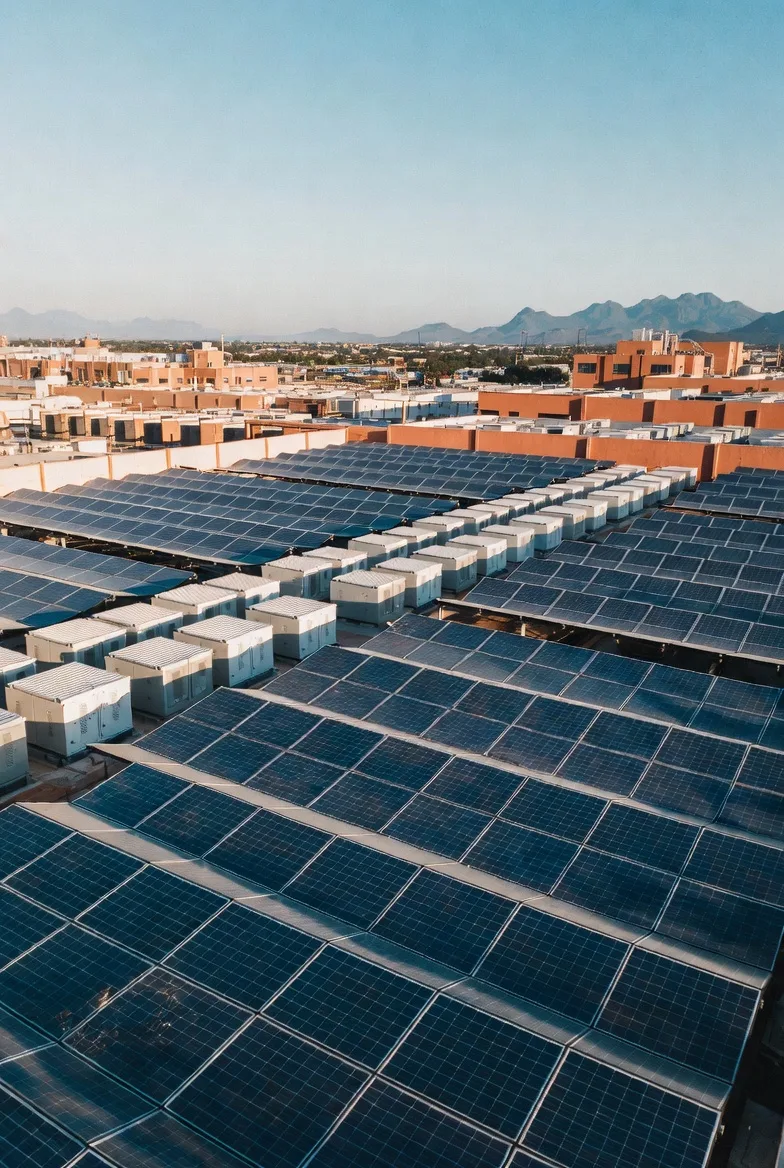
Supplier development and manufacturing projects for the Bajío's electrical supply chain.
Let's discuss your projectIn 2024 Mexico exported USD 7.43 billion of transformers, static converters and inductors; 95% went to the United States. In the same year it imported USD 6.73 billion of the same category, almost half from China. The country is a major assembler of electrical equipment, and yet CFE buys much of its own abroad and waits its turn in international queues.
The conclusion is not that factories are missing. It is that what goes inside them is missing.
The base is already in the Bajío
The Guanajuato–Querétaro–San Luis Potosí corridor holds an electrical manufacturing base few regions of the country can match:
- Siemens Energy has built power and distribution transformers in Guanajuato since 1981: more than 1,000 units a year and about 400 employees as of 2021. The company says the plant is undergoing an expansion that will triple its capacity. In November 2025 it opened a distribution-transformer plant in León (25 kVA to 10 MVA), and it has operated another in Querétaro since 2010.
- ABB completed the expansion of its San Luis Potosí campus in July 2025: medium- and low-voltage distribution equipment, USD 12 million, 50% more capacity.
- Schneider Electric runs three plants in Querétaro totalling about 115,000 m² and projects more than 4,000 direct jobs by the end of 2027.
- LS Cable & System announced in January 2026 a USD 157 million investment in Querétaro for data-centre bus ducts and automotive cable.
- Condumex has 15 wire-harness plants in Guanajuato and two automotive-cable plants in Querétaro.
Much of this capacity grows facing north: it is assembly and finished product, and its expansions are justified by North America’s grid and data centres.
The bottleneck is inside
Siemens Energy said it in August 2026: some of the components in its transformers have lead times of up to three years. A bigger plant does not shorten the wait if the core, the bushings or the tap changer still come from abroad.
The clearest case is grain-oriented electrical steel (GOES), the sheet every transformer core is made of. The US Department of Commerce put it on record in 2021: “Neither Mexico nor Canada has indigenous production capability for GOES”; Japan is the main source, with additional purchases from China and Russia. Even so, Mexico supplied 45% of the transformer cores the United States imported in that study. We cut and stack someone else’s steel and ship it north.
Copper tells a similar story. Mexico mined about 690,000 tonnes in 2025, ninth in the world according to the USGS. The ore is here; enamelled winding wire is a separate link.
What should be made here
| Link | Today | Why in the Bajío |
|---|---|---|
| Transformer cores (cutting, stacking, winding) | Made in Mexico for export; the steel is imported | The skills and a local customer already exist: the transformer plants in Guanajuato, León and Querétaro |
| Long-lead components (bushings, tap changers, insulation, radiators, tanks) | Siemens Energy reports components with lead times of up to 3 years | They set the delivery date; tanks and radiators are heavy and expensive to ship |
| Magnet wire and conductor | Domestic copper exists; the Bajío’s cable base is automotive | Drawing and enamelling lines are transferable from automotive harness work |
| Medium-voltage switchgear and panels | ABB and Schneider already manufacture in the region | What is missing is LAPEM qualification to sell to CFE |
| Storage integration (enclosure, power conversion, controls) | Cells are imported; local assembly has only been announced | Integration happens close to the project; the 935 MW tender creates the first demand |
Four criteria for choosing
- Lead time. First, whatever sets the delivery date of a transformer or substation today, not what can already be had in weeks.
- Weight and volume. Tanks, radiators and structures carry expensive freight; making them less than a day’s truck ride away is an immediate advantage.
- Qualification. Without CFE approval there are no domestic orders. The process is long and should start before the plant exists.
- Two markets. A link that can sell to CFE and export under the USMCA spreads the risk. No plant should depend on a single buyer.
What not to attempt
A GOES mill or a battery-cell plant demands global scale and years on the learning curve; the Commerce Department study itself identifies a single GOES producer in the United States. The Bajío does not win by competing there. It wins in the next link: taking imported steel and turning it into a core, taking domestic copper and turning it into a winding, taking the cell and turning it into a certified system.
The window is that of CFE’s plan: most of the investment is spent between 2026 and 2028. Whatever is not made here in that period will be bought abroad, on foreign lead times.
Sources: Data México, power transformers, static converters and inductors, 2024 trade · Government of Guanajuato, Siemens Energy Guanajuato 40th anniversary, Mar 2021 · Global Energy, Siemens Energy accelerates investment in the Americas, Aug 2026 · Puerto Interior, Siemens Energy in León, Nov 2025 · Líder Empresarial, Siemens Energy Querétaro, 2022 · ABB, San Luis Potosí campus expansion, Jul 2025 · Clúster Industrial, Schneider Electric in Querétaro, Aug 2026 · Clúster Industrial, LS Cable & System in Querétaro, Jan 2026 · Puerto Interior, Condumex in Guanajuato, Jul 2024 · US Department of Commerce, Section 232 report on transformers and components, 2021 · USGS, Mineral Commodity Summaries 2026: copper · ESS News, Pomega and Jebla, Oct 2025
Bajío Ventures — a Mexican energy-infrastructure investment group based in Guanajuato: capital, a data platform on the region’s industrial base, and a German industrial channel, with its own advisory presence in Berlin.
Supplier development and manufacturing projects for the Bajío's electrical supply chain.
Let's discuss your projectThis article is also available in Spanish. Read in Spanish