Technology
Sovereign AI: what it means and which open models exist
Sovereignty in artificial intelligence does not mean building everything at home: it means being able to decide. Open-weight models already solve the model layer. The missing layer is electrical, and that layer is decided substation by substation.
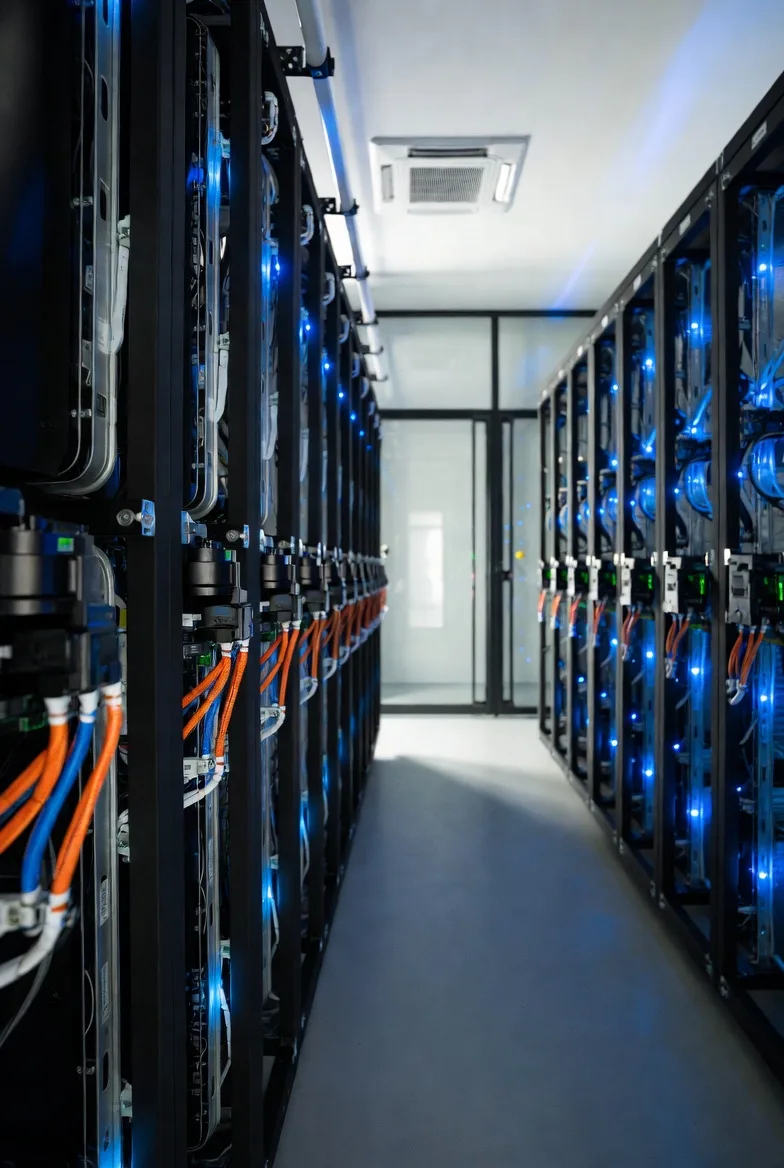
Energy and infrastructure for compute and industrial loads in the Bajío.
Let's discuss your projectBajío Ventures · October 2026 · Sovereign AI: series guide
The company that sells the chips made the term popular. In February 2024, in Dubai, Jensen Huang said that a country’s artificial intelligence “codifies your culture, your society’s intelligence, your common sense, your history”, and that this is why each country must own its data. Two years later, Nvidia reported that its “sovereign AI” sales exceeded USD 30 billion in its fiscal year 2026. It is useful to separate the seller’s argument from the underlying question.
What it means, without the slogan
The most useful definition comes from the Tony Blair Institute (January 2026): AI sovereignty is “the ability of a state to make deliberate, future-oriented decisions about how AI is integrated, governed and used in line with its national goals”. In the foreword, Tony Blair warns: “isolation and protectionism do not protect sovereignty; they weaken it”.
Brookings (February 2026) reaches the same conclusion by a different route. Full-stack sovereignty is “structurally infeasible for almost any country”. What exists is a spectrum of strategies, not autarky, and the practical alternative is “managed interdependence”.
Sovereignty, then, is the ability to decide and to change provider. It is not self-sufficiency.
Five layers, and the first is energy
In Davos, in January 2026, Huang described AI as a “five-layer cake”. It works as a map of where the dependencies are:
| Layer | Who controls it today | What a mid-sized country can do |
|---|---|---|
| 1. Energy | Each country | Build generation and grid. It is the only layer that is entirely local. |
| 2. Chips | Nvidia: most of the accelerators in the world’s cloud regions are its own (Oxford, 2025) | Buy. There is no substitute in the short term. |
| 3. Data centers and cloud | The large providers from the United States and China | Build or attract local capacity, with clear rules. |
| 4. Models | Laboratories in the United States and China | Use open weights. Everything changed here in 2025–2026. |
| 5. Applications | Whoever knows the process | Build them. This is where the value stays. |
Why it matters: jurisdiction, not geography
The CLOUD Act of 2018 allows US authorities to request data from a US provider even when the data is stored in another country. On 10 June 2025, before the French Senate and under oath, the director of public and legal affairs at Microsoft France was asked whether he could guarantee that the data of French citizens would not be handed over without France’s agreement. He answered: “No, I cannot guarantee it, but, again, it has never happened.”
The same reasoning applies to a cloud region in Querétaro operated by a US provider: the location of the server does not change the jurisdiction of the provider.
What an open-weight model is
A language model is, in the end, a file of numbers: the weights. If the developer publishes that file, anyone can download it and run it on their own equipment. No data leaves the plant and nobody can switch off the service.
Three clarifications prevent most errors:
- Open weights is not open source. The Open Source Initiative definition (October 2024) also requires the code and the information about the training data. Few models meet it.
- The licence decides. Apache 2.0 and MIT permit commercial use without restriction. Other licences set revenue or user thresholds, or prohibit commercial use.
- The open model does not solve the other layers. The Tony Blair Institute puts it this way: open models make it possible to “inspect, fine-tune and operate models within localised and secure environments”, but “openness cannot deliver full AI sovereignty” while compute and cloud remain concentrated.
The map, as of October 2026
| Family | Origin | Most recent open model | Size | Licence |
|---|---|---|---|---|
| Aleph Alpha Kolibri-1 | Germany | 3 Oct 2026 | 78 billion (3.46 billion active) | Apache 2.0 |
| Mistral Small 4 and Large 3 | France | Mar 2026 and Dec 2025 | 119 billion and 675 billion | Apache 2.0 |
| Google Gemma 4 | US | Apr 2026 | up to 31 billion | Apache 2.0 |
| OpenAI gpt-oss | US | Aug 2025 | 21 billion and 117 billion | Apache 2.0 |
| IBM Granite 4.1 | US | Apr 2026 | 3, 8 and 30 billion | Apache 2.0 |
| Meta Muse Glimmer | US | Aug 2026 | 30 billion | Apache 2.0 |
| Alibaba Qwen3.8 | China | Aug 2026 | 27 billion / 2.4 trillion | Apache 2.0 / Alibaba’s own licence |
| Xiaomi MiMo-V2.6 | China | Sep 2026 | up to 1.02 trillion | MIT |
| ALIA-40b | Spain | 2025–2026 | 40 billion | Apache 2.0 |
| Latam-GPT | Chile (CENIA), with data from 20 countries | 2026 (presented in February) | 70.6 billion | Llama 3.1 Community |
Size in parameters. “Active” parameters are the ones the model uses for each word it generates; the rest must be loaded in memory.
Two facts organize the map. First, the distance to the closed models is short: Epoch AI measured in May 2026 that the best open models are, on average, four months behind the best closed models. Second, the open leadership is Chinese: models from China accounted for 41% of downloads on Hugging Face in the year before the March 2026 report, and as of 5 October 2026 the five highest-rated open models in the Artificial Analysis index come from Chinese laboratories.
For industry, another column matters: where the model runs. Google states that the 31-billion-parameter Gemma 4 fits on a single 80 GB GPU. Mistral states a minimum infrastructure of 4× NVIDIA HGX H100 for Small 4. The Chinese flagship models, from hundreds of billions to more than one trillion parameters, need a data center.
The missing layer is electrical
The International Energy Agency measured 485 TWh of data center consumption in 2025, 17% more than a year earlier; the data centers dedicated to AI grew 50%. It projects close to 950 TWh in 2030. By 2027, a single rack of AI servers could have a peak demand equivalent to that of 65 households.
In Mexico the constraint already has numbers. CFE and the data center association agreed in September 2026 on a work plan for 1,705 MW of projects, against 279 MW installed and 205 MW under construction. According to CloudHQ’s experience in Querétaro, the electrical infrastructure can add about three years to the schedule of a data center. The public supercomputer Coatlicue will have 14,480 GPUs; as a reference of scale, the Deutsche Telekom industrial cloud in Munich operates with almost 10,000.
The model downloads in an afternoon. The substation takes years. It is the same diagnosis we made for industry: the bottleneck is the grid.
What it means for a plant in the Bajío
- The model is no longer the barrier. A model of 20 to 30 billion parameters under an Apache 2.0 licence runs on a server inside the plant. The process data does not leave.
- Read the licence before the benchmark. Several families in the table have versions with commercial conditions.
- Ask about the jurisdiction of the provider, not the city of the data center.
- If the project is at data center scale, start with the interconnection. It is the variable that defines the schedule.
- The value stays in the application. It is the same logic we reviewed in electromobility and in Industry 5.0.
In this series: 1. Aleph Alpha: the German lesson · 2. Mistral: Europe’s champion and its licences · 3. United States: open weights, closed flagship · 4. China: 41% of downloads · 5. Spanish-language models and the case of Mexico
Sources: Nvidia, World Governments Summit, Feb 2024 · Nvidia, Davos, Jan 2026 · Nvidia, Q4 FY2026 earnings call · Tony Blair Institute, Sovereignty in the Age of AI · Tony Blair Institute, Open Source · Brookings, Is AI sovereignty possible? · Oxford Internet Institute, AI Compute Sovereignty · US Department of Justice, CLOUD Act · French Senate, hearing of 10 Jun 2025 · Open Source Initiative, Open Source AI Definition · OpenAI, gpt-oss, Aug 2025 · Epoch AI · Hugging Face, State of Open Source, Spring 2026 · Artificial Analysis · IEA, Key Questions on Energy and AI · DCD, CFE and MEXDC · SECIHTI, Coatlicue · Deutsche Telekom
Bajío Ventures — a Mexican energy-infrastructure investment group based in Guanajuato: capital, a data platform on the region’s industrial base, and a German industrial channel, with its own advisory presence in Berlin.
Energy and infrastructure for compute and industrial loads in the Bajío.
Let's discuss your projectThis article is also available in Spanish. Read in Spanish