Thesis
Expensive, stable, long-term rules: what an investor is looking for
Infrastructure investors don't ask for cheap rules. They ask for rules they can price and that last as long as the asset. An expensive rule is paid once; an unstable rule is charged on every cash flow, through the discount rate.
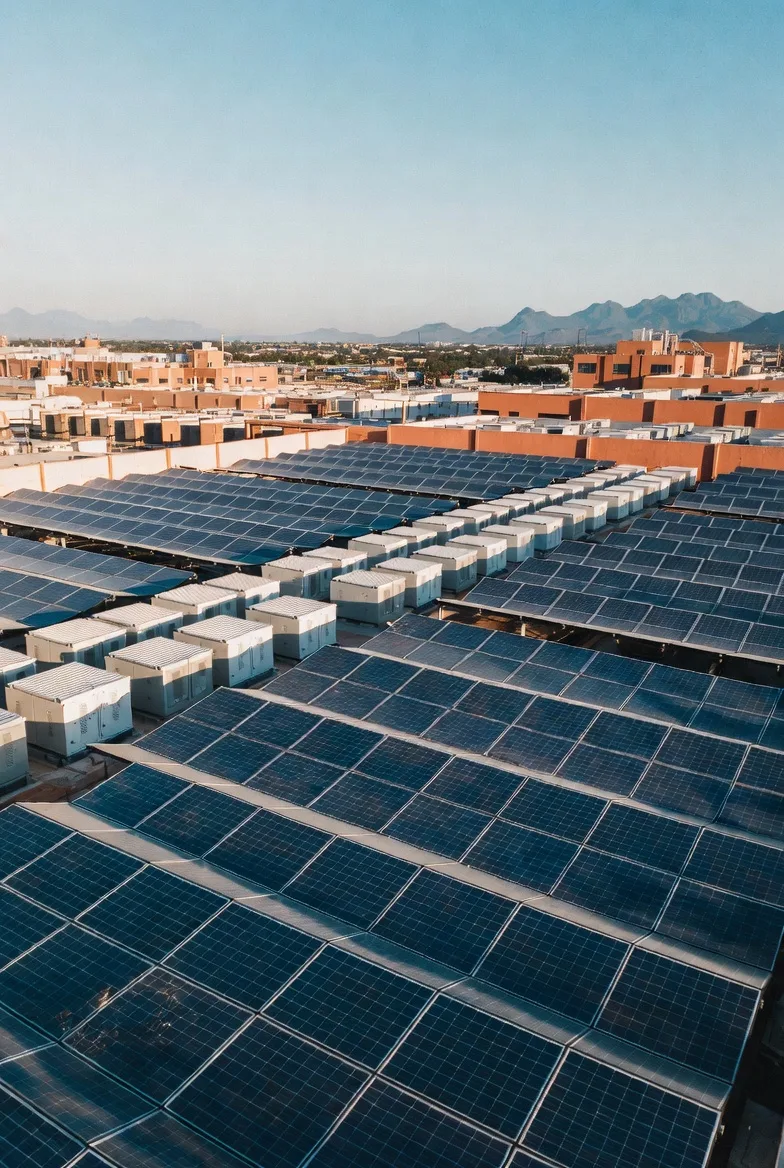
Energy projects in the Bajío structured to last as long as the asset.
Let's discuss your projectBajío Ventures · September 2026
Ask what a country needs to attract infrastructure investment and the intuitive answer is cheap rules: few requirements, low taxes, fast permits. It is the wrong answer.
A power project is paid for almost entirely on day one and recovered over 20 or 30 years. What its owner needs is not a cheap rule but a rule it can price and that lasts as long as the asset. An expensive but stable rule enters the financial model as one more cost and is paid once. A cheap but unstable rule never makes it into the model: it is charged on every cash flow, through the discount rate.
The price of uncertainty
A solar or wind plant has almost no fuel cost. What you pay for is capital. That is why the International Energy Agency (IEA) estimates that the cost of capital accounts for 20% to 50% of the levelised cost of electricity (LCOE) of a utility-scale solar plant. In 2019 it ranged from 2.6% to 5.0% in Europe and the United States, and from 8.8% to 10.0% in India. In emerging economies capital generally costs at least twice as much as in advanced ones.
Where does the gap come from? In the IEA survey of investors and financiers across nine emerging economies —Mexico among them— five risks stood out: political instability, currency, regulatory uncertainty, off-taker creditworthiness and inadequate transmission. Three of the five are rules.
A simple calculation shows the size of the effect. For a 25-year asset, the annual charge needed to recover capital is:
| Cost of capital | Annual charge per 100 invested |
|---|---|
| 6% | 7.8 |
| 10% | 11.0 |
Four points of risk premium raise the capital charge by 41% — the same effect as a rule that raised capex by 41%. No regulator would impose such a requirement on purpose, yet a rule that can change mid-contract imposes it without noticing.
Arithmetic illustration using the capital recovery factor; excludes taxes, debt structure and degradation.
Three stories
Germany: an expensive rule that was kept
Germany’s Renewable Energy Sources Act (EEG) of 2000 guaranteed investors a fixed payment for their power for 20 years. It was an expensive scheme, paid for two decades through a surcharge on consumers’ electricity bills. When that surcharge became politically heavy, Germany removed it from bills in July 2022 and moved the cost to the federal budget.
What matters is what did not change: the state changed who pays, not what it had promised. The first projects completed their 20 years of guaranteed payment in 2021.
Spain: a cheap rule to break
Royal Decree 661/2007 offered generous tariffs to renewables and drew around EUR 13 billion in foreign investment. In 2013, with the tariff deficit growing, Royal Decree-Law 9/2013 and Law 24/2013 abolished the fixed tariff and replaced it with a “reasonable return”, applied to plants already built.
The fiscal saving was immediate. The bill came later: more than 50 claims under the Energy Charter Treaty and, as of 2024, at least USD 1.5 billion in unpaid awards, plus interest and costs. By 2024 Spain was being singled out as the state with the most unpaid investment awards. What it saved on tariffs it paid in litigation and risk premium.
Mexico: the cheapest auction, and the last
In November 2017 Mexico’s Third Long-Term Auction closed at an average price of USD 20.57 per MWh —among the lowest ever recorded worldwide— for 2,562 MW and an estimated USD 2.4 billion of investment.
That price was not a gift from the Mexican sun. It was the result of a credible rule: long-term contracts with CFE’s basic-supply arm as the main buyer, awarded through a public, competitive process. With that certainty, developers could finance with cheap debt and pass the lower cost into the price.
The fourth auction was suspended on 3 December 2018 and cancelled on 31 January 2019. Mexico has not seen a price like that since. The low price was a product of stability; when stability came into question, the price went with it.
What it means for Mexico today
The framework that emerged from the 2024 constitutional reform and the March 2025 Electricity Sector Law is, for private capital, more expensive than the 2014 one:
- The state must control at least 54% of the energy injected into the grid each year.
- Binding planning decides how much capacity is needed, of what type and where; permits are aligned to it.
- Mixed-investment schemes require at least 54% state participation and last a maximum of 30 years.
None of that, by itself, drives away an infrastructure investor. It is a cost, and costs can be modelled. The proof: the mixed scheme with CFE received about six times more applications than the capacity on offer (see the state of energy investment schemes).
The question that sets the cost of capital is a different one: will it last? The current framework has in its favour that it sits in the Constitution and in statute, not just in policy, and that it is published with calendars and figures. Against it are recent history —two fundamental reversals in little more than a decade— and the fact that much of the operating detail (market rules, CNE provisions, standard interconnection contracts) was still pending at the end of 2025. Every rule published on time and honoured lowers the premium. Every exception raises it.
What an investor is looking for
Before the cost of a rule, an investor checks six things:
- Rules written before investing, not negotiated afterwards.
- Contract term equal to or longer than the asset’s financial life. A 25-year plant under 6-year rules is a bet, not an investment.
- Changes that apply forward, never backward. Every new rule must respect projects already built.
- An independent referee that rules on time. A permit or dispute with no response date is unpriced risk.
- Published calendars that are kept. A call for projects that opens when it said it would is worth more than a generous one that keeps slipping.
- A buyer that pays. The best contract is worthless if the counterparty cannot honour it.
The cost of the rule comes after. An expensive rule that meets these six conditions gets financed. A cheap rule that fails any of them gets charged in the rate.
For the Bajío
Stability is not only federal. A project in the Bajío also depends on state and municipal rules: land use, building licences, water, rights of way. There, states and municipalities have room of their own.
A state cannot always compete on incentives, but it can compete on predictability: published requirements, maximum response times, criteria that do not change with each administration. For someone investing over 25 years, a municipality that answers in 60 days every time is worth more than one that sometimes answers in 15.
Conclusion
An expensive rule that lasts 25 years is a cost. A cheap rule that lasts one administration is a risk. Costs get financed; risks get charged.
In 2017 Mexico showed that, with credible rules, it can produce some of the cheapest power in the world. The task is not to make the new framework’s rules cheaper, but to make them last.
Sources: IEA, The Cost of Capital in Clean Energy Transitions · IEA, cost of capital survey in emerging economies (Nov 2023) · Clean Energy Wire, end of EEG guaranteed payment · Clean Energy Wire, end of the EEG surcharge on bills · Arbitration Monitor, awards against Spain · Energías Renovables, Third Auction results (Nov 2017) · pv magazine México, fourth auction cancelled (Feb 2019) · IMCO, new electricity market rules (Oct 2025)
Bajío Ventures, operating under the Bajío Invest brand, is a Mexican energy infrastructure investment group based in Guanajuato: capital, a data platform on the regional industrial base and a German industrial channel, with its own advisory presence in Berlin.
Energy projects in the Bajío structured to last as long as the asset.
Let's discuss your projectThis article is also available in Spanish. Read in Spanish